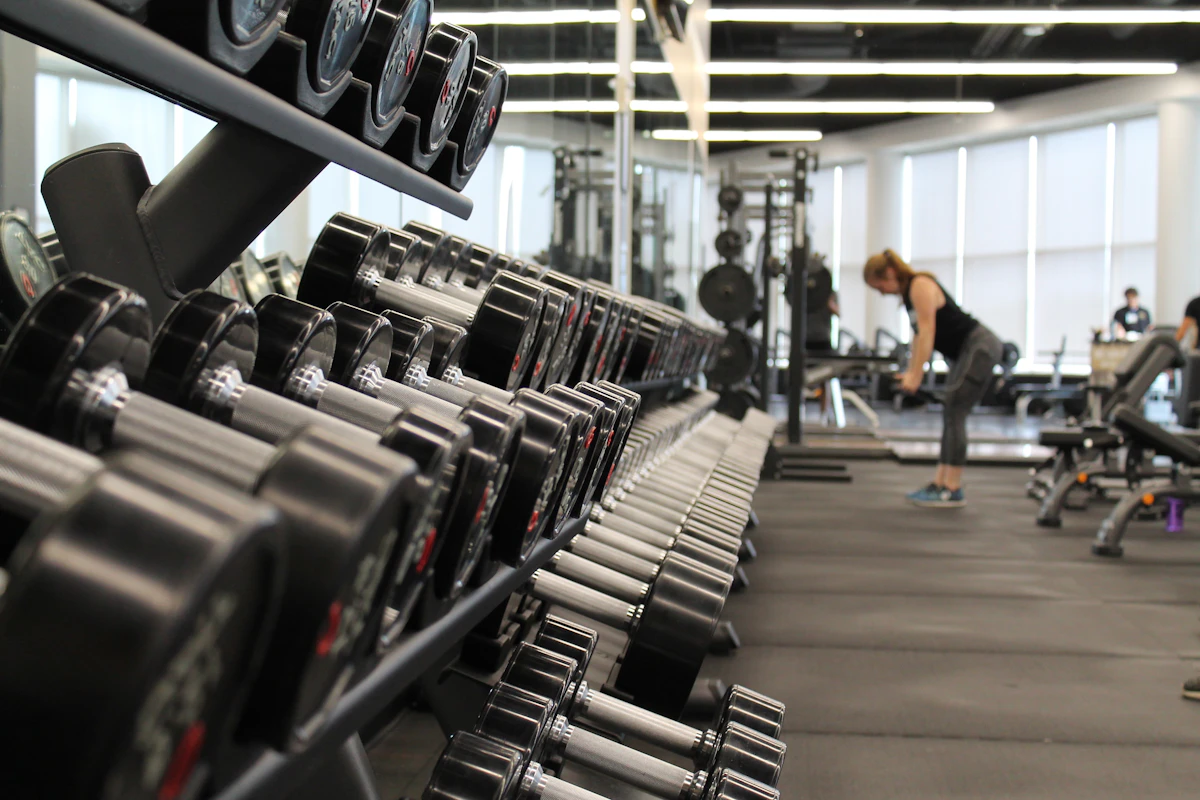
Adjustable dumbbells solve a real problem: a full rack of fixed dumbbells from 5 to 50 pounds costs thousands and occupies a wall. A single pair of adjustables replaces fifteen pairs for a few hundred dollars and fits under a desk.
The trade-offs are also real, and most buying guides skip them. Adjustables are bulkier at low weights, most cannot be dropped, the adjustment mechanism is a failure point fixed dumbbells do not have, and the cheapest ones have genuine durability problems. This guide covers which mechanism suits which lifter, what the current models cost, and when a cheap fixed set is the better purchase.
The three mechanisms, and what each is good at
Dial / selector pin (Bowflex SelectTech)
Turn a dial at each end and the handle picks up the plates you selected. Fastest to change, most beginner-friendly, and the design most people picture. The downside is length — the housing is the same size at 5lb as at 50lb, so the dumbbell is awkwardly long for pressing movements and some people’s shoulders dislike the wide grip path.
Twist-handle plate loading (NÜOBELL)
Rotate the handle itself to select the weight, then lift out of the cradle. The plates are flat and round, so the finished dumbbell looks and balances much more like a fixed one. Widely considered the best feel of the three. More expensive, and the mechanism is more intricate.
Stacked block with a pin (PowerBlock)
A nested cage of rectangular blocks with a selector pin. Shortest of the three by a wide margin, extremely durable, and the only design that reliably tolerates being set down hard. The shape is the acquired taste — your hand sits inside a cage, which some people find restrictive on curls and presses.
Which mechanism for which lifter
Dial for beginners and anyone prioritising speed of change. Twist-handle for people who care about feel and are doing a lot of dumbbell work. Blocks for small spaces, heavier lifters, and anyone who expects to be less than gentle with their equipment.
The main options, with current pricing
Prices checked September 2026. This category discounts frequently and sale pricing is common — treat these as reference points.
NÜOBELL 580 — around $595 per pair, 5 to 80 lb
The current consensus pick for overall quality. Fast twist-handle adjustment, compact, and the flat plate profile gives it the most natural feel of any adjustable. The 5-80lb range also means most people will not outgrow it.
Best for: anyone doing serious dumbbell work who will feel the difference in balance. Watch for: the price, and a more intricate mechanism than the alternatives.
Bowflex SelectTech 552 — around $349 per pair, 5 to 52.5 lb
The default recommendation for most home gyms and frequently discounted to around $299. Dial adjustment in 2.5lb increments up to 25lb, which is genuinely useful for smaller accessory lifts where a 5lb jump is too coarse.
Best for: beginners, general home training, and anyone who wants the simplest possible adjustment. Watch for: the length at low weights, and do not drop them.
Bowflex SelectTech 1090 — around $549 each, up to 90 lb
Sold individually rather than as a pair, which makes a full set expensive. Worth it only if you are genuinely pressing or rowing above 52.5lb per hand.
Best for: stronger lifters who have outgrown the 552. Watch for: per-unit pricing — a pair is over a thousand dollars.
PowerBlock Elite EXP — around $399, expandable
Steel construction with a 5-year residential warranty, and the expandable design lets you add weight stages later rather than replacing the set. Survives handling that would destroy a dial-based unit.
Best for: small spaces, durability, and buyers who want to start lighter and expand. Watch for: the cage shape, which is the main thing people either accept or dislike immediately.
Ironmaster Quick-Lock — premium, screw-collar design
Plates lock on with a quick screw rather than a selector. Slower to change than any of the above — think 15-20 seconds rather than 3 — but the result is effectively a fixed dumbbell in feel and durability, and it can be dropped. Often carries a lifetime warranty.
Best for: lifters who value durability and feel over adjustment speed, and who do not superset frequently. Watch for: the change time, which genuinely disrupts circuit-style training.
Budget spin-lock sets — under $150
Threaded handles with collars you screw on and off. Cheap, and the change takes a minute or more per adjustment. Fine for slow strength work; miserable for anything with supersets or drop sets.
Best for: the smallest budgets. Watch for: collars working loose mid-set, which is the common failure and genuinely hazardous overhead.

The honest downsides nobody mentions
You cannot drop most of them
This is the single biggest practical limitation. Dial and twist-handle mechanisms are precision assemblies; dropping them cracks housings and bends selector pins. That rules out true failure-point training on presses unless you have a spotter or are willing to fight the weight down. PowerBlock and Ironmaster tolerate this far better.
Length at light weights
A 10lb SelectTech is the same physical length as a 50lb one. For lateral raises, rear delt work, and anything where the dumbbell travels near your body, that extra length changes the movement and can feel clumsy.
The adjustment mechanism is a failure point
A fixed dumbbell has nothing to break. An adjustable has a mechanism that will eventually wear, especially if you change weights dozens of times per session. Warranty length is a genuine differentiator here, not marketing.
They are slower than a rack
Three seconds sounds fast until you are doing a drop set and need three changes in thirty seconds. For most training this is irrelevant; for high-density circuit work it is a real friction.
Cradle footprint
The dumbbells are compact; the cradles they sit in are not. Factor the cradle into your space calculation, not just the dumbbell.
Resale and repair
Fixed dumbbells are effectively immortal and hold value. Adjustables depreciate and can become unusable if a proprietary part fails out of warranty. Check whether replacement parts are actually sold before buying.
When NOT to buy adjustable dumbbells
If you only need light weights
A pair of fixed 10s, 15s, and 20s costs well under $150, takes no space, lasts forever, and is better in every way for lighter accessory work. If you are not going above 25lb, adjustables are solving a problem you do not have.
If you mainly want one heavy pair
For goblet squats and rows at a fixed load, a single pair of heavy fixed dumbbells is cheaper and more robust.
If you train explosively
Snatches, dumbbell clean and press, anything you might need to drop — fixed dumbbells or PowerBlock/Ironmaster only. Dial-based units will not survive this.
If a barbell would serve you better
For pure strength on squats, presses, and deadlifts, a barbell and plates is more effective per dollar than any dumbbell set. Dumbbells win on unilateral work, space, and safety without a rack — not on raw loading.
If you already have a gym membership you use
Buying a home setup to duplicate equipment you already access is a common and expensive mistake. Our home gym equipment guide covers what is genuinely worth owning versus what the gym does better.
What to actually check before buying
Weight range vs. your real lifts
Look at your current working weights on dumbbell press, row, and goblet squat, then add headroom for two years of progress. Most people need less top-end than they think and more bottom-end granularity than they expect.
Increment size
5lb jumps are coarse for lateral raises and curls. The 552’s 2.5lb increments up to 25lb are genuinely useful. Check the increments in the range where you actually do isolation work.
Warranty length and terms
The mechanism is the part that fails. A 5-year residential warranty versus a 2-year one is a meaningful difference in expected cost of ownership.
Whether replacement parts exist
Search the manufacturer’s site for spare selector pins and plates before buying. Brands that sell parts expect their products to last; ones that do not, do not.
Handle diameter and knurling
Rarely mentioned and immediately noticeable. Smooth plastic handles get slippery with sweat; some adjustables have genuinely poor grip texture.
Cradle stability
You will be returning a heavy object to a plastic cradle repeatedly. Flimsy cradles crack, and a dumbbell that does not seat properly will not adjust.
Cost per pound, and the real comparison
Adjustables versus a fixed rack
A pair of SelectTech 552s covers 5 to 52.5lb in 2.5lb increments — roughly the equivalent of fifteen pairs of fixed dumbbells. Buying those fixed pairs new at typical retail runs well past $1,500 and occupies several feet of floor with a rack. At around $349, the adjustables are dramatically cheaper per pound of coverage.
Where the comparison flips
If you only need three or four specific weights, fixed wins outright on price, durability, and feel. The break-even is somewhere around five or six pairs — below that, buy fixed.
Used fixed dumbbells
Worth mentioning because it is the genuinely cheapest route. Secondhand fixed dumbbells are widely available, essentially indestructible, and priced far below new. If you have space and patience, a used set beats adjustables on every metric except footprint.
The hidden cost of outgrowing them
Buying a 5-25lb budget set and then replacing it eighteen months later costs more than buying the 52.5lb set once. If you are training consistently, buy for where you will be in two years.
What a full home setup actually costs
Adjustable dumbbells plus an adjustable bench covers the large majority of effective home training. That is roughly $500-800 all in, and it will not become the limiting factor in your progress for years.
Getting the most from a pair of adjustables
Programming around slower changes
Structure sessions so you are not changing weight constantly — group all your pressing at one load, then all your rowing, rather than alternating. This removes most of the friction people complain about.
Use a bench
An adjustable bench roughly doubles what a pair of dumbbells can do — incline press, decline work, supported rows, step-ups, Bulgarian split squats. It is the single best companion purchase.
Mind the return
Most mechanism damage happens when setting the dumbbell down, not lifting it. Seat them deliberately in the cradle. This one habit accounts for most of the difference between a set that lasts eight years and one that cracks in two.
Do not train to absolute failure overhead
With equipment you cannot safely drop and no spotter, leave a rep in reserve on overhead pressing. This is a genuine safety point, not a performance one.
Keep them out of damp
Garage and basement storage with humidity swings corrodes selector pins and steel plates. If that is your space, favour the more robust designs and wipe them down.
Check the mechanism periodically
Every few months, cycle through the full weight range and confirm each setting engages cleanly. Catching a sticky selector early is far cheaper than discovering it mid-press.
Buying by situation
Apartment, shared walls, limited floor
PowerBlock. It is the shortest design by a clear margin, tolerates being set down on a hard floor, and the cradle footprint is small. Add a rubber mat regardless — it protects the floor and dampens noise for whoever lives below you.
Garage gym alongside a barbell
The dumbbells are accessory work here, not the main event. A 5-52.5lb pair is plenty, and durability matters because garage conditions are harder on equipment. PowerBlock or Ironmaster.
Total beginner, first equipment purchase
SelectTech 552 plus an adjustable bench. It is the most intuitive to use, the increments are appropriate for the accessory work beginners do most, and you will not outgrow the top end for years.
Already strong, dumbbells are the main lift
NÜOBELL 580 if budget allows — the feel difference is genuinely noticeable when you are doing high volume, and the 80lb top end has real headroom. Otherwise SelectTech 1090s, accepting the per-unit pricing.
Training mostly circuits and conditioning
Adjustment speed dominates. Dial or twist-handle only; the screw-collar and spin-lock designs will wreck the pacing of circuit work.
Rehab, physical therapy, very light loads
Buy fixed. A set of 3s, 5s, 8s, and 10s costs under $100, weighs nothing, and is far more pleasant to handle than an adjustable at its minimum setting.
Buying for two people of different strength
Adjustables genuinely shine here — one pair serves a 15lb lifter and a 45lb lifter with a three-second change. This is one of the strongest cases for the category, and a point in favour of the wider 5-80lb range.
What to pair them with
An adjustable bench — the highest-value companion
Flat, incline, and decline positions roughly double your exercise library: incline press, chest-supported rows, seated shoulder press, step-ups, Bulgarian split squats, hip thrusts. Expect $150-300 for something sturdy. Buy this before any other accessory.
A rubber mat
Protects the floor, protects the dumbbells when you set them down, and dampens noise. Cheap, and it extends the life of the equipment you just spent hundreds on.
Resistance bands
Cover what dumbbells do poorly — pull-aparts, face pulls, lateral walks, and the whole category of light rotator cuff and glute medius work where even 5lb is too heavy. See our guide to resistance band arm workouts.
A pull-up bar
The one major movement pattern dumbbells cannot replicate well. A doorway bar costs very little and closes the biggest gap in a dumbbell-only setup.
What you do not need
Weighted vests, specialty bars, cable attachments, and most gadgets marketed alongside dumbbells. The dumbbells plus a bench plus a bar is a complete home gym for the overwhelming majority of people, for years.
Programming to match
A dumbbell-and-bench setup supports full-body training three times a week, or an upper/lower split four times. Our dumbbell exercises guide covers the movements worth building that around.
Prices and model availability were checked in September 2026 and change frequently in this category — sale pricing is common. Confirm current price and stock on the manufacturer’s site before buying.
How the mechanisms fail, and what that means for you
Dial systems
The common failure is a selector that no longer picks up the correct plate stack, usually after a drop or after being returned to the cradle at an angle so the mechanism does not seat. The symptom is a dumbbell that lifts out with the wrong weight attached, or plates rattling loose. It is repairable if the manufacturer sells the part, and a write-off if not.
Twist-handle systems
More moving parts, and the failure tends to be gradual — the handle becomes stiff or vague between settings. Regular use actually helps; the units that seize are usually ones left at one setting for months in a damp space.
Block systems
The most robust by a clear margin. The realistic failure is a bent selector pin, which is inexpensive and replaceable. This is the main reason PowerBlock has a reputation for lasting a decade in garages.
Screw-collar systems
Almost nothing to fail. The threads are the only wear point and they are heavily over-engineered. This is the trade you make for slower adjustment.
Spin-lock budget sets
The collar is the failure, and it fails by loosening during a set rather than breaking. That is a safety issue rather than a durability one, and it is the single strongest argument for spending more.
What warranty actually covers
Read whether the warranty is “residential” or “commercial” and whether it covers the mechanism specifically or only the plates. Drop damage is almost never covered on any of them, which circles back to the most important handling habit: set them down deliberately.
A note on how we chose these
These picks reflect the current consensus across independent equipment testers who have actually used the units over time, cross-checked against manufacturer specifications and current pricing in September 2026. We have not tested every unit in a lab, and we say so rather than implying otherwise. Where a product carries a premium we have tried to state plainly what that premium buys — and in the case of the 90lb units and the budget spin-lock sets, why we think most people should skip them.
Nobody paid for placement. Adjustable dumbbells are a category where the honest answer for a lot of readers is “buy fewer, cheaper, fixed ones,” and that answer appears above in the section on when not to buy adjustables at all.
Setting up a dumbbell-only training week
Three days, full body
The most efficient structure for a dumbbell setup. Each session: one squat pattern (goblet squat, split squat), one hinge (Romanian deadlift, single-leg RDL), one press (flat or incline), one row, and one carry or core movement. Rotate which variation you use each session so you are not repeating identical loading three times a week.
Four days, upper/lower
More volume per muscle group and better if you enjoy longer sessions. Upper days lean on press and row variations with lateral and arm work; lower days on split squats, RDLs, hip thrusts, and calf work. The main constraint is that heavy lower-body work becomes limited by what you can hold rather than what your legs can lift — which is why single-leg variations dominate dumbbell leg training.
Working around the loading ceiling
At some point your legs will be stronger than your grip. The answer is not heavier dumbbells; it is harder variations. Bulgarian split squats, tempo work, 1.5 reps, and pauses all raise the difficulty without raising the load. This is why a 52.5lb ceiling lasts most people far longer than they expect.
Progression without a full rack
With 5lb jumps you cannot always add weight, so progress through reps first — take a set from 8 to 12 over a few weeks, then add weight and drop back to 8. This double-progression approach is well suited to adjustables specifically because the increments are coarse.
What you will miss
Heavy bilateral squatting and deadlifting, and true maximal pressing. If those are your priorities, dumbbells are the wrong primary tool and a barbell setup is the better spend. For general strength, muscle, and conditioning at home, a pair of adjustables and a bench is genuinely sufficient for years.
What adjustable dumbbells cost you beyond the price tag
The sticker price is the easy part of this decision. The parts people underestimate are floor space, adjustment friction, and resale.
Floor space is not just the dumbbells — it is the cradle plus the clearance to pick them up and set them down without knocking a wall. A pair in their trays occupies roughly the footprint of a small side table, and they need to live somewhere you can reach mid-session rather than in a cupboard. If they end up in the cupboard, you have bought a fixed-weight set with extra steps.
Adjustment friction matters more than any spec sheet suggests. A dial system that changes weight in three seconds lets you run drop sets and supersets normally. A pin-and-plate system that takes twenty seconds per side quietly reshapes your programming — you start avoiding exercises that require a weight change, and within a month you are training a narrower range of movements than you intended. If you know you will be doing a lot of alternating work, weight it heavily.
Resale is the underrated upside. Used adjustable dumbbells from the established brands hold value unusually well, largely because shipping cost makes local pickup the norm and local supply is thin. Buying the better set and selling it in three years is frequently cheaper in real terms than buying the budget set and replacing it in one.
Frequently asked questions
Are adjustable dumbbells worth it?
For most home gyms, yes — a single pair replaces roughly fifteen pairs of fixed dumbbells for a few hundred dollars and a fraction of the space. They are not worth it if you only train with light weights, need to drop the weights, or already have gym access.
What is the best adjustable dumbbell in 2026?
The NÜOBELL 580 is the general consensus pick for feel and build, at around $595 a pair. The Bowflex SelectTech 552 at around $349 is the better value for most people, and PowerBlock is the durability and small-space choice.
Can you drop adjustable dumbbells?
Generally no. Dial and twist-handle mechanisms are precision assemblies that crack or bend when dropped. PowerBlock and Ironmaster designs tolerate rough handling far better, which matters if you train close to failure without a spotter.
Bowflex or PowerBlock?
Bowflex is faster to adjust and more conventional in shape. PowerBlock is shorter, considerably more durable, expandable, and survives being dropped. Choose Bowflex for convenience, PowerBlock for durability and tight spaces.
How much weight do I actually need?
Most people are well served by a 5-52.5lb range. Only buy the 90lb units if you are already pressing or rowing above 50lb per hand — they cost substantially more and are sold individually.
Are cheap adjustable dumbbells any good?
Spin-lock sets under $150 work, but adjustment takes a minute or more and collars can loosen mid-set, which is genuinely unsafe overhead. They are acceptable for slow strength work and poor for anything with supersets.
Do adjustable dumbbells feel like real dumbbells?
The twist-handle designs come closest because the plates are flat and round. Dial-based units are noticeably longer, and block designs place your hand inside a cage. None feel identical to a fixed dumbbell.
How long do adjustable dumbbells last?
The mechanism is the limiting factor rather than the weight. Well-built units last many years of home use; the failure mode is usually a cracked housing from a drop or a worn selector. Check that replacement parts are sold before buying.