
A single pair of dumbbells is the most versatile piece of strength equipment ever invented. With one set of weights, you can train every major muscle group in your body through a near-infinite combination of movements, you can scale difficulty without changing equipment, and you can do it all in 30 square feet of floor space at home. This guide is a complete reference: the 24 most useful dumbbell exercises, what they train, common form mistakes, and a 4-week beginner program that turns those exercises into a real strength routine.
Quick Hit
You don’t need a rack of weights. One adjustable pair (5-50 lbs) covers nearly every exercise in this guide for the next 2-3 years of training. Three sessions a week, 6-8 exercises per session, 3 sets of 8-12 reps each — that’s a complete strength program.
Why dumbbells beat machines for most home lifters
Three reasons. First: they require stabilization, which trains the small supporting muscles that machines neutralize. Second: they allow natural movement paths — your shoulder, elbow, and wrist move where they want, not where a fixed track forces them. Third: they fit anywhere. A pair of dumbbells under your bed gives you the same training potential as a $3,000 home gym for the first 2-3 years of serious lifting.
For beginners and intermediates, a single adjustable pair handles 90% of useful training. The remaining 10% can wait until you’ve outgrown what dumbbells can do — which most people never quite do.
Upper body push (chest, shoulders, triceps)
1. Dumbbell bench press
Lie on a bench, dumbbells over your shoulders, palms facing forward. Lower under control to chest level, then press up. Trains chest, front delts, triceps. Reps: 8-12. The dumbbell version recruits more stabilizer muscles than barbell bench and is friendlier to the shoulder.
2. Dumbbell shoulder press
Sit or stand. Hold dumbbells at shoulder height, palms forward. Press straight up overhead. Lower to start. The shoulder press is the cornerstone vertical-push exercise. Reps: 8-12.
3. Dumbbell incline press
Same as flat bench, but bench is set at 30-45 degrees. Shifts more load to the upper chest and front delts. Reps: 8-12. Critical for balanced chest development.
4. Dumbbell lateral raise
Stand with dumbbells at your sides. Raise arms out to the sides until parallel with the floor. Lower with control. Trains the medial deltoids — the muscle that creates broader-looking shoulders. Reps: 12-15.
5. Dumbbell front raise
Stand with dumbbells in front of thighs, palms facing back. Raise straight forward to shoulder height. Lower. Trains the front delts. Reps: 12-15.
6. Tricep kickback
Hinge forward at the hips, knees soft. Pin elbows to your sides. Extend forearms back until straight, squeezing the triceps. Lower. Reps: 12-15 per arm.
Upper body pull (back, biceps, rear delts)
7. Bent-over dumbbell row
Hinge forward at the hips with a flat back, dumbbells hanging straight down. Row both dumbbells up toward your hips, squeezing your shoulder blades. Lower with control. Hits the lats, rhomboids, mid-traps, and biceps. Reps: 8-12.
8. Single-arm dumbbell row
Place one knee and one hand on a bench. Dumbbell in the opposite hand. Row up to your hip, elbow tucked. The supported position allows heavier loading and more controlled focus. Reps: 8-12 per side.
9. Renegade row
From a plank position with hands on dumbbells, row one weight up while bracing the core hard. Alternate sides. Trains lats + core + anti-rotation. Reps: 8-10 per side. Brutal but uniquely efficient.
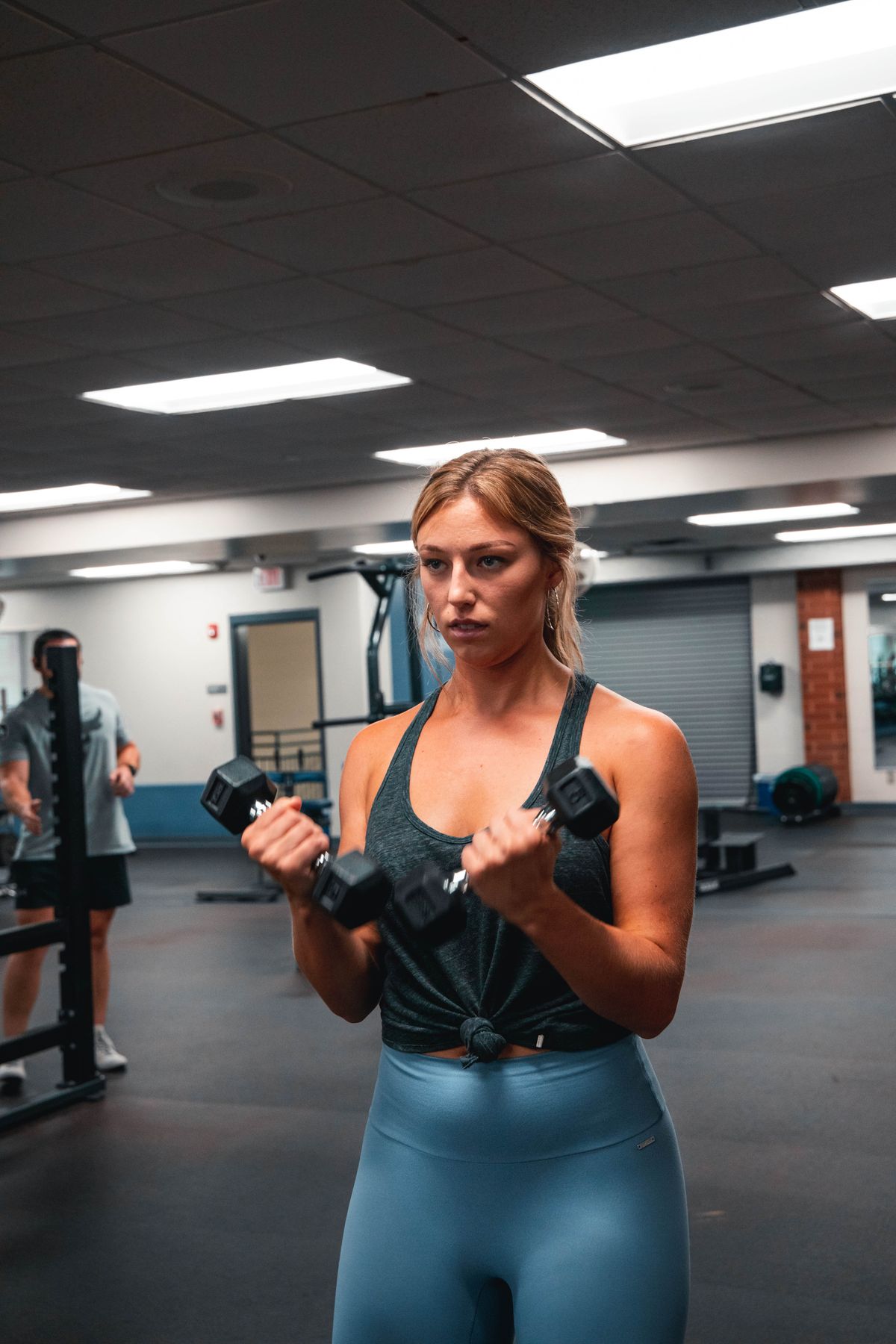
10. Bicep curl
Stand with dumbbells at your sides, palms forward. Curl up to shoulder level. Lower with control. The classic. Reps: 10-15.
11. Hammer curl
Same as bicep curl but with palms facing each other (neutral grip). Targets the brachialis (under the biceps) and the brachioradialis (forearm). Reps: 10-15.
12. Reverse fly
Hinge forward, arms hanging down with palms facing each other. Raise both arms straight out to the sides, squeezing shoulder blades. Hits the rear delts and mid-back. Reps: 12-15.
Lower body (quads, glutes, hamstrings)
13. Goblet squat
Hold one dumbbell vertically at your chest. Squat down with knees tracking over toes, chest up. Drive through your heels to stand. Best beginner squat variation. Reps: 10-15. See our glute exercises pillar for more squat progressions.
14. Dumbbell Romanian deadlift
Hold dumbbells in front of thighs. Hinge at hips, push hips back, lower weights along legs to mid-shin. Stand by driving hips forward. Hamstrings + glutes + back. Reps: 8-10.
15. Dumbbell lunge
Hold dumbbells at sides. Step forward with one leg, lower until back knee nearly touches floor. Drive through front heel to return. Alternate or complete all reps on one side. Reps: 10 per leg.
16. Bulgarian split squat
Back foot elevated on a bench, dumbbells at sides. Lower straight down on the front leg. Drive up through front heel. Brutal for glutes and quads, exposes imbalances. Reps: 8-10 per leg.
17. Single-leg Romanian deadlift
One dumbbell in opposite hand. Hinge forward on standing leg, extending back leg straight behind. Single-leg posterior chain work. Reps: 8-10 per side. Pair with our hamstring stretching guide.
18. Step-up
Hold dumbbells at sides. Step one foot onto a bench or sturdy box. Drive through that heel to stand fully on the box. Lower with control. Reps: 8-10 per leg.
Core (and full-body)
19. Russian twist with dumbbell
Sit, lean back slightly, feet elevated. Hold one dumbbell in both hands. Twist side to side, touching the weight to the floor next to each hip. Trains the obliques. Reps: 20 total twists.
20. Dumbbell sit-up
Hold one dumbbell at your chest. Standard sit-up motion. Added load amplifies the difficulty. Reps: 10-15.
21. Farmer’s carry
Hold a heavy dumbbell in each hand. Walk forward 40-50 feet maintaining upright posture, shoulders down, core braced. Walk back. Trains grip, traps, core, total-body stability. Distance: 40-50 feet x 3-4 trips.
Compound full-body moves
22. Dumbbell thruster
Hold dumbbells at shoulders. Squat down, then explosively stand and press the weights overhead. Squat + press combination is the most metabolic dumbbell movement available. Reps: 8-10.
23. Dumbbell clean
From the floor, explosively pull dumbbells from below your knees to your shoulders in one motion. Trains the entire posterior chain plus traps. Reps: 5-8 (this is a power movement, not a pump movement).
24. Dumbbell snatch
From between your feet, pull one dumbbell explosively overhead in one motion. Single-side power exercise. Reps: 5-6 per side.
Form Over Load
More weight with bad form trains nothing. Slow eccentric (lowering) phase, controlled concentric, full range of motion. If you can’t keep form for the last 2 reps of a set, drop weight by 5-10 lbs. Always.
A 4-week beginner dumbbell program
Schedule
3 sessions per week (Monday / Wednesday / Friday). Each session 35-45 minutes. Rest 60-90 seconds between sets.
Session A (push focus)
Dumbbell bench press 3×10. Shoulder press 3×10. Lateral raise 3×12. Tricep kickback 3×12. Goblet squat 3×12. Russian twist 3×20.
Session B (pull focus)
Single-arm row 3×10/side. Bent-over row 3×10. Bicep curl 3×12. Reverse fly 3×12. Romanian deadlift 3×10. Farmer’s carry 3 trips.
Session C (full body)
Dumbbell thruster 3×8. Bulgarian split squat 3×8/side. Renegade row 3×8/side. Step-up 3×10/side. Hammer curl 3×12. Sit-up with dumbbell 3×12.
Add 2.5-5 lbs per session when the last set feels easy. By week 4, most beginners are handling 25-50% more weight than week 1.
What weight should I buy?
For complete beginners
One pair of 15-lb dumbbells covers shoulder presses, lateral raises, and bicep curls. Add a pair of 25 or 30-lb dumbbells for heavier rows and presses. Total cost: $80-120.
The smarter long-term buy: adjustable dumbbells
A pair of adjustable dumbbells (Bowflex SelectTech, PowerBlock, NÜOBELL) covers 5-50 lbs per dumbbell in one compact unit. $300-500 upfront, but replaces 8+ pairs of fixed weights and saves enormous space. The best home-gym investment most people will ever make.
For more advanced lifters
50-lb pair, 70-lb pair, plus an adjustable bench. Total $400-700. Covers everything in this guide indefinitely.
Common dumbbell training mistakes
Using too much weight
Most beginners ego-lift — they pick weights they can barely curl, then swing their whole body to complete reps. The muscle never gets trained. Drop weight, slow down, focus on form.
Skipping the eccentric
The lowering phase is where 60% of muscle growth happens. Most people speed through it. Take 2-3 seconds to lower every rep.
No progressive overload
If you’re doing the same 3 sets of 10 with the same weight for months, you’ve plateaued. Either add reps, add sets, add weight, or change the exercise to keep progressing.
Training only what you can see
Most home lifters drift into chest + arms training and neglect back, glutes, and posterior shoulder. Balance every push with a pull. Every quad day with a posterior chain day. Long-term aesthetics and health depend on it.
Skipping warm-ups
5 minutes of light dumbbell movement (light reps of your first exercise, plus some arm circles, glute bridges, and dynamic stretches) prevents 90% of training injuries. Don’t skip it.
How long until you see results?
Weeks 1-2: Neural adaptation
You’ll get visibly stronger fast — not because your muscles grew yet, but because your brain learned to recruit them better. Most beginners can lift 30-50% more by end of week 2 than they did on day 1.
Weeks 3-6: Early hypertrophy
Muscle starts to thicken. Subtle visual changes — arms feel firmer, shoulders look fuller, posture improves. Most people start to feel “in shape” by week 6.
Weeks 6-12: Visible change
Real muscle definition becomes visible. Other people notice. Clothes fit differently. Strength gains continue at a slower pace.
Beyond 12 weeks
Gains slow but continue for years. Adding 2-5 lbs to your main lifts every month is realistic for the first 1-2 years of consistent training.
Pairing with nutrition
Dumbbell training without adequate protein produces underwhelming results. Aim for 0.7-1 gram of protein per pound of bodyweight, daily, for muscle growth. See our high-protein breakfast guide and protein bars guide for ideas.
For mobility work that supports better lifting form, pair this program with our hip flexor stretches, hamstring stretches, and a 5-minute warm-up before each session.
Keep reading
Dumbbell Exercises FAQ
What dumbbells should I buy as a beginner?
A pair of 15-lb and a pair of 25-30 lb fixed dumbbells covers 90% of beginner exercises ($80-120). For long-term value, adjustable dumbbells (5-50 lbs per side, $300-500) replace 8+ pairs and save substantial space.
Can you build muscle with just dumbbells?
Yes. Dumbbells provide everything required for muscle growth — progressive resistance, full range of motion, and the ability to train all major muscle groups. Most home lifters can make real gains for 2-3+ years with one good pair before needing additional equipment.
How often should I do dumbbell workouts?
3 times per week is the sweet spot for most beginners and intermediates. More than that doesn’t add proportional benefit until you’re advanced. Allow 48 hours between sessions training the same muscle group for full recovery.
What’s the best dumbbell exercise for overall strength?
The dumbbell thruster (squat + press combination) trains the most total muscle in a single rep. The Romanian deadlift and goblet squat are also high-value compounds. Combining 2-3 of these across the week covers most of what total-body strength requires.
How heavy should my dumbbells be?
Heavy enough that the last 2 reps of each set are challenging but you can still maintain form. If you can’t finish the set with good form, weight is too heavy. If you could easily do 5 more reps, weight is too light.
How long should a dumbbell workout be?
35-45 minutes per session for most beginners and intermediates. Beyond an hour, cortisol rises and recovery suffers. Focus on intensity per minute, not total duration.
Can dumbbells replace a gym membership?
For most lifters, yes — for the first 2-3 years. Beyond that, heavy barbell work (300+ lb squats, deadlifts) requires equipment dumbbells can’t replicate. But the 90% of training that gets the average person fit, strong, and lean is fully achievable with a dumbbell pair at home.
Should I do cardio with dumbbells?
The thruster, snatch, clean, and farmer’s carry create significant cardiovascular demand in addition to strength. A circuit of 4-5 of those done with shorter rest periods produces the same heart-rate response as moderate cardio while building muscle. Best of both worlds.
Keep going
Three dumbbell sessions a week paired with reasonable nutrition transforms most beginners within 12 weeks. Browse more workout guides on EatFitFuel or pair with our glute exercises pillar and deadlift guide to expand your routine.
Related on EatFitFuel