
The basic push-up is one of the most useful exercises ever invented — but it’s also the start of a tree of variations that can train your chest, shoulders, triceps, back, and core through endlessly progressive challenge levels for years. Most people stick with standard push-ups, plateau at 15 reps, then assume they need a barbell to make further gains. They don’t. This guide walks through 24 push-up variations organized by difficulty and target, the form fundamentals that make each one work, and a 6-week progression plan that takes you from your first knee push-up to one-arm push-ups if that’s where you want to go.
Quick Hit
Push-up variations let you train the chest through every angle (incline for upper, decline for lower), every grip width (narrow for triceps, wide for outer pec), and every difficulty level (knee for beginners, archer and one-arm for advanced) without any equipment. Master 6-8 variations and you’ve built a complete push routine.
The push-up’s anatomy
The push-up trains the chest (pectoralis major), shoulders (anterior deltoids), and triceps as the prime movers, plus the core (transverse abdominis, rectus abdominis), serratus anterior, and stabilizers throughout the upper body. By changing hand position, angle, tempo, and stability, you can shift the emphasis dramatically while staying with bodyweight.
The form fundamentals that apply to every variation
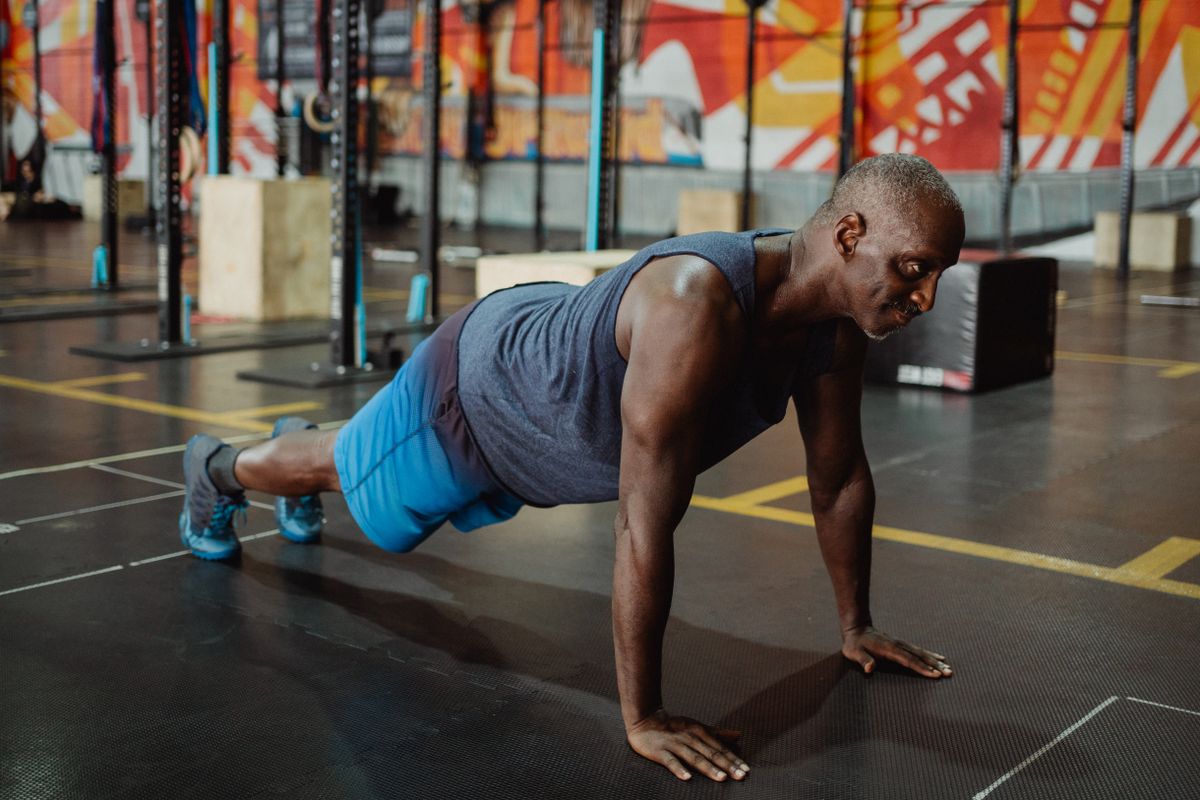
1. Maintain a rigid plank
From heels to head, your body should move as one solid unit. Hips don’t sag or pike. Core stays braced throughout every rep. If the line breaks, you’re cheating reps. See our plank training guide for the foundation.
2. Full range of motion
Chest comes within 1-2 inches of the floor (or lower for variation depth). Arms fully lock out at the top — but don’t snap or hyperextend. Partial reps train almost nothing.
3. Shoulders packed
Shoulder blades retract slightly at the bottom and protract at the top. Shoulders don’t shrug up to ears — they stay down and away from the neck.
4. Elbows track 45 degrees
Elbows should travel back and slightly out at roughly 45 degrees to the body — not flared straight out (90 degrees) which stresses the shoulders, and not tucked tight to the body which makes it a tricep-only movement.
5. Controlled tempo
2-3 seconds lowering (eccentric), 1 second at the bottom, 1-2 seconds pushing back up. Fast bouncing reps build very little compared to slow controlled work.
Beginner push-up variations
1. Wall push-up
Stand 2 feet from a wall. Place hands on the wall at shoulder height. Lower your chest to the wall, push back. The easiest progression — perfect for building the movement pattern from zero. Reps: 12-15.
2. Incline push-up (counter or bench)
Hands on a kitchen counter or bench, feet on the floor, body in a straight line. The angle reduces the load on your chest and arms. The higher the surface, the easier the rep. Reps: 8-12.
3. Knee push-up
Standard push-up but on your knees instead of toes. Keep the body line from knees to head straight — don’t pike your hips. Reps: 8-12. The right next step after incline push-ups feel easy.
4. Negative push-up
Start at the top of a push-up position. Take 4-5 seconds to lower yourself to the floor. Drop your knees, push back up. Repeat. The slow eccentric builds strength fast for people who can’t yet do a full push-up. Reps: 6-8.
Standard and intermediate push-up variations
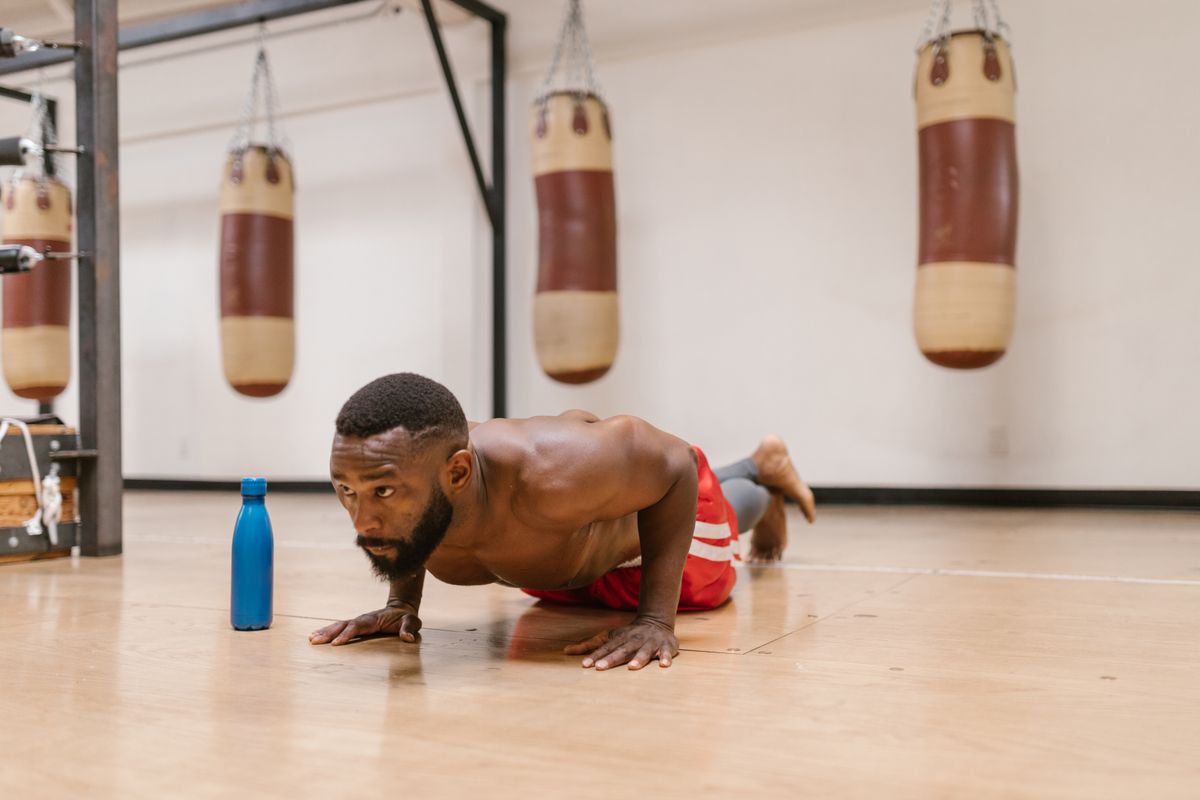
5. Standard push-up
Hands shoulder-width apart, body in a straight line from heels to head. Lower until chest nearly touches floor, push back. The benchmark. Reps: 10-20.
6. Wide-grip push-up
Hands placed wider than shoulders (about 1.5x shoulder width). Shifts more load to the outer chest, slightly less to triceps. Reps: 10-15.
7. Diamond (narrow) push-up
Hands close together under the chest, index fingers and thumbs forming a diamond shape. Shifts almost all the load to the triceps. Brutal. Reps: 6-10.
8. Decline push-up
Feet on a bench or chair, hands on the floor. The angle shifts more load to the upper chest and front delts. Effectively replaces incline bench press for bodyweight training. Reps: 8-12.
9. Tempo push-up (5-second descent)
Standard push-up, but take 5 seconds to lower. The slow eccentric increases time under tension dramatically, multiplying strength gains without adding reps. Reps: 6-8.
10. Pause push-up
Lower to the bottom, hold for 2 seconds, then push back. Eliminates the bounce and tendon-elasticity carryover — pure muscle work. Reps: 6-10.
11. Spider-Man push-up
As you lower, drive one knee out to touch the same-side elbow. Alternate sides each rep. Adds significant oblique recruitment. Reps: 8-10 per side.
12. Hindu (dive bomber) push-up
Start in a downward-dog position. Lower your chest in a swooping motion, then push up to an upward-dog position. Trains shoulders, chest, and triceps through extended range. Reps: 6-10.
Advanced push-up variations
13. Plyometric (clap) push-up
Push up explosively, lifting both hands off the floor and clapping. Land softly into another rep. Builds power. Don’t attempt until you can do 15+ strict standard push-ups. Reps: 5-8.
14. Archer push-up
Hands wider than shoulders. As you lower, shift weight to one side (working arm bends, opposite arm stays straight). Push back. Alternate sides. The stepping stone to one-arm push-ups. Reps: 5-8 per side.
15. Pseudo-planche push-up
Place hands at hip level (fingers pointing toward your feet) instead of at shoulders. Lean forward slightly as you lower. Massive shoulder demand. Reps: 5-8.
16. One-arm push-up (assisted then full)
The goal of all push-up progression. Start with assisted (one hand on a bench, the working arm on the floor). Progress to feet wide for balance, then feet together. Reps: 3-6 per side.
17. Handstand push-up (assisted)
Kick up to a handstand against a wall. Lower your head to the floor, push back up. Trains shoulders and triceps similarly to overhead press. Reps: 3-6.
18. Push-up to T (or Y)
From the top of a push-up, lift one hand off the floor and rotate your body to point that arm at the ceiling. Lower, push back up, repeat on the other side. Anti-rotation and shoulder mobility combined. Reps: 6-8 per side.

Specialty push-up variations
19. Staggered push-up
One hand higher than the other (one on a book, one on the floor). Trains each side slightly differently and exposes imbalances. Reps: 10-12 per side.
20. Cross-body push-up
Place one hand directly in front of the other (forming a straight vertical line). Adds rotational stability demand. Reps: 6-8 per side.
21. Push-up with shoulder tap
From the top of a push-up, lift one hand to tap the opposite shoulder. Lower, push up, alternate. Anti-rotation work. Reps: 8-10 per side.
22. Push-up to renegade row
Hold dumbbells in plank position. Do a push-up, then row one dumbbell up at a time. Alternates push/pull in a single rep. Reps: 6-8.
23. Side-to-side push-up
From a wide-grip starting position, shift your weight side to side at the bottom of each rep. Each shift forces one arm to work harder. Reps: 5-8 per side.
24. Plyometric to chest tap
Like the clap push-up but tap your chest instead of clapping. Slightly less air time but same power demand. Reps: 5-8.
A 6-week push-up progression
Weeks 1-2: Build the foundation
3 sessions per week. Each session: 4 sets of 8-10 reps of wall, incline, or knee push-ups (whatever level lets you complete the sets with form). Focus on tempo and range.
Weeks 3-4: Standard transition
3 sessions per week. Each session: 3 sets of standard push-ups (or 5-second negatives if standard isn’t yet possible). Add 2 sets of wide-grip or decline at the end.
Week 5: Intensify standard
Add tempo push-ups (5-second descent) and pause push-ups. Sessions: 3 sets of standard + 2 sets of tempo + 1 set of pause.
Week 6: Introduce variations
Mix in archer push-ups (assisted version), diamond push-ups for triceps, and Spider-Man variations. Sessions: 3 sets standard + 2 sets archer + 2 sets diamond + 2 sets Spider-Man.
By the end of week 6, most beginners can complete 15-25 standard push-ups with form, plus handle harder variations. Pair with our dumbbell exercises program for complete strength training.
How many push-ups should you do?
For general fitness
3 sessions per week, 4-6 sets of 8-15 reps. Progress by adding variations or pushing closer to failure on the last set.
For muscle building
3-4 sessions per week, multiple variations per session (4-5 different types), 3-4 sets each near failure. Add weight (push-ups with a backpack) once you’ve maxed out bodyweight variations.
For maintenance
2 sessions per week of standard + one harder variation. 20-40 total reps per session is enough to maintain.
Tempo Hack
If you’re stuck at the same standard push-up count for weeks, change tempo before changing variation. 5-second descents for 6 reps build more strength than 15 fast reps. Time under tension is the variable most beginners ignore.
Common push-up mistakes
Sagging hips
The most common error. Hips drop because the core isn’t engaged. Brace the abs like you’re about to take a punch. Squeeze the glutes hard throughout.
Piked hips
The opposite problem. Hips raise toward the ceiling — usually because the shoulders or core are tired. Fix: drop reps and rebuild form before pushing volume.
Partial range of motion
Stopping 6 inches above the floor builds very little. Chest must come within 1-2 inches of the floor (or touch lightly for full depth).
Elbows flared 90 degrees
Stresses the shoulder joint and reduces chest engagement. Keep elbows at 45 degrees from the body.
Speeding through reps
Fast bouncing uses tendon elasticity instead of muscle. Slow descent + brief pause + controlled push beats fast reps every time.
Skipping variations
People plateau at standard push-ups and quit. Variations are the answer — they let you keep progressing without any equipment.
What if push-ups hurt your wrists?
Use push-up handles or dumbbells
Holding handles or dumbbells keeps the wrist neutral instead of bent back 90 degrees. Almost completely eliminates wrist pain.
Knuckle push-ups
Make fists and push on your knuckles (on a mat for cushioning). Wrist stays straight. Builds wrist and forearm strength as a bonus.
Wrist mobility work
Between sessions, do wrist circles, gentle flexion/extension stretches, and prayer stretches. 5 minutes a day improves wrist tolerance dramatically.
Push-Up Variations FAQ
What’s the best push-up variation for chest?
Wide-grip push-up and decline push-up (feet elevated). Both shift load to the chest and away from triceps. For maximum chest emphasis, combine decline + wide-grip + slow tempo.
What push-up variation builds triceps?
Diamond push-up (hands close together) and narrow-grip push-up (hands at shoulder width or narrower). Both push tricep recruitment to ~70% of the work.
How do I progress from knee to standard push-ups?
Three options: (1) 5-second negatives from the top of a standard push-up, (2) incline push-ups gradually lowering the surface, (3) hybrid sets — some standard, drop to knees when fatigue hits. Most people can transition in 2-4 weeks.
How many push-up variations should I do in one workout?
3-5 variations is the sweet spot. Hit one chest-focused, one tricep-focused, one core-focused, and rotate the rest. More than 5 variations dilutes training quality.
Can push-ups build muscle?
Absolutely — for beginners and intermediates. Once you can do 25+ standard push-ups with form, progress comes from variations (harder mechanical positions) or added load (weighted vest, backpack). Most people can build noticeable upper-body muscle with push-up variations alone for 1-2 years.
How often should I do push-up variations?
3 sessions per week with at least 48 hours between sessions training the same muscles. Daily push-ups work for general fitness but cap muscle-building potential.
What’s the hardest push-up variation?
The one-arm push-up (with feet together, not staggered) is the gold standard. Plyometric variations like clap push-ups and pseudo-planche push-ups are also extremely demanding. Most people take 1-2 years of training to achieve clean reps of these.
Do push-ups work the back?
Indirectly. The lats and rhomboids stabilize during push-ups, but they’re not prime movers. For balanced upper-body development, pair push-ups with rowing exercises (renegade rows, dumbbell rows) and pull-ups when possible. See our pull-up guide for the pull side.
Keep going
Push-ups are the foundation of bodyweight upper-body training — master variations and you’ve built a complete chest, shoulder, and tricep program. Pair with our dumbbell exercises, pull-up training, and plank guide for full upper-body strength. Browse more workout guides on EatFitFuel.
Related on EatFitFuel