
Most morning workouts fail for the same reason most morning routines fail. They’re too long, too involved, or they require you to be the kind of person who has already gotten up early to stretch and journal and meditate before sunrise. They’re built for the person you wish you were, not the one currently still in bed.
Six minutes is different. Six minutes is doable on a Tuesday. It’s shorter than the time you spend deciding whether to hit snooze. It is the workout you can do in pajamas, on your bedroom floor, before your brain has fully booted up — and that’s exactly the point.
The structure
Six bodyweight movements, one minute each. No equipment. No warm-up needed because the workout itself is the warm-up. The “burn fat” framing is honest if you understand the mechanism: you’re not torching calories, you’re building a daily-movement floor that compounds over months.
What “burn fat in the morning” actually means
Let’s clear something up first, because the internet is full of nonsense on this. A six-minute workout does not burn meaningful body fat by itself. The math is straightforward — six minutes of high-effort movement burns roughly 50–80 calories. That is a quarter of a granola bar.
What it does do is create the conditions in which body fat actually changes over time:
- It primes your nervous system for the rest of the day, which means you move more total minutes — incidentally and otherwise.
- It anchors a daily movement habit, which is the only sustainable predictor of long-term body composition change.
- It raises your morning heart rate and breathing, which seems to nudge meal choices toward less inertia-driven snacking later in the day.
In other words: the six-minute workout is a leverage point. It works because of what it sets in motion — not because of what happens in those six minutes alone.
The 6-minute workout
Six exercises. Sixty seconds each. No rest between movements. Move from one straight into the next.
| Min | Movement | How to do it |
|---|---|---|
| 1 | Slow squats | Stand feet shoulder-width. Lower for 3 seconds, stand for 1. Smooth and steady — this is your warm-up. |
| 2 | Push-ups | Knees down or full. Five-second rests as needed but keep moving. Quality over count. |
| 3 | Glute bridges | Lying on your back, knees bent, feet flat. Drive hips up so your body forms a line from knees to shoulders. Squeeze the glutes at the top. |
| 4 | Mountain climbers | Plank position. Drive knees toward chest one at a time, alternating fast. Steady breathing. |
| 5 | Reverse lunges | Step one leg back into a lunge, return, alternate legs. Slow and controlled — no momentum. |
| 6 | Plank | Forearm plank. Body straight from heels to head. Hold the full minute. Breathe. |

That’s the workout. Done.
Why each movement is here
The order is not random. Each minute serves a specific purpose in waking the body up and building the morning baseline.
Minute 1 — Slow squats: prime the legs
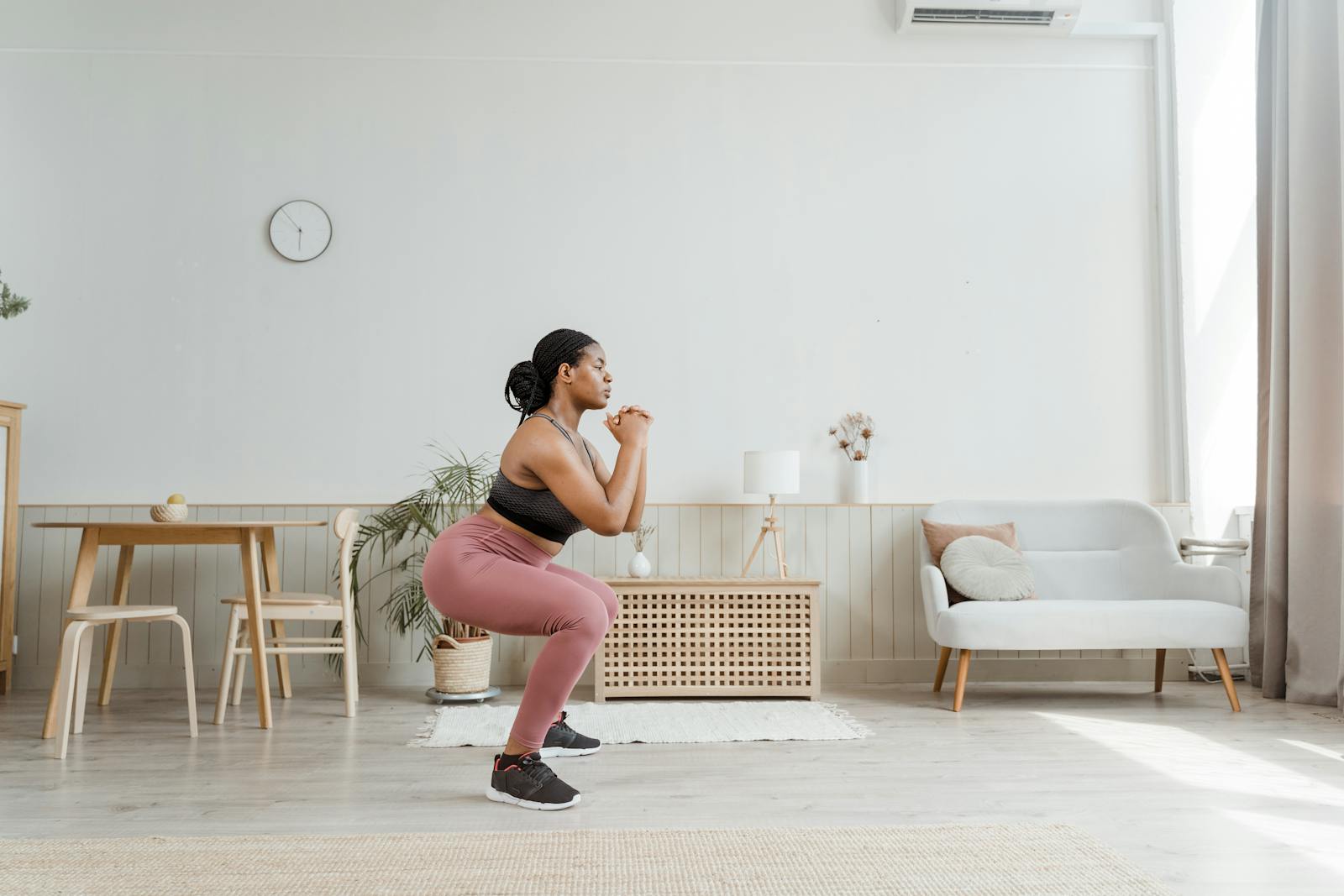
Squats are the most efficient lower-body wake-up. They warm up the largest muscle groups (quads, glutes, hamstrings), open the hip joints, and gently raise heart rate. Slow tempo here — this is not a strength set. The whole minute should feel like easing into the day, not attacking it.
Minute 2 — Push-ups: turn on the upper body

Push-ups activate chest, shoulders, triceps, and the entire core in one movement. After a night of stillness, the upper body needs a coordinated wake-up signal more than it needs a stretch. Push-ups deliver that.
Minute 3 — Glute bridges: counter the chair
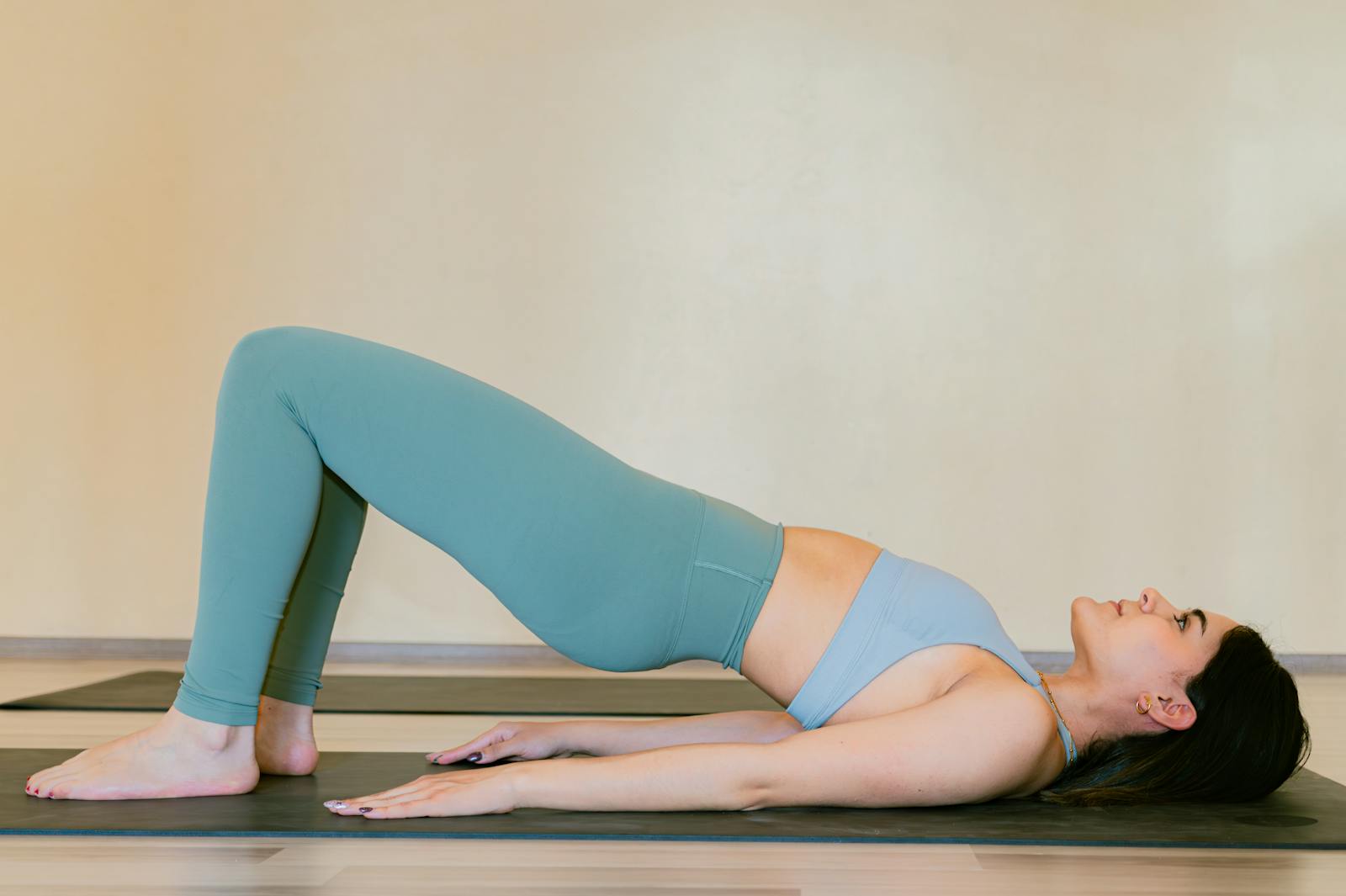
Most adults sit for 8+ hours per day. The glutes go quiet, the hip flexors get tight, and posture suffers. Sixty seconds of glute bridges every morning is the simplest possible counter-measure. Within 2 weeks of daily use, hip mobility noticeably improves.
Minute 4 — Mountain climbers: push the heart rate
This is the cardio peak of the workout. Mountain climbers combine plank stability with rapid leg movement, which spikes heart rate quickly without requiring a treadmill or jumping. By the end of this minute you should be breathing hard.
Minute 5 — Reverse lunges: balance and unilateral strength
Reverse lunges are joint-friendlier than forward lunges and they expose left/right balance issues. Daily exposure to single-leg work is one of the highest-value movements you can add for long-term athletic longevity.
Minute 6 — Plank: finish with the core
Holding a plank for 60 seconds at the end of the circuit is harder than it sounds when your shoulders are already pumped. That’s the point. The plank consolidates everything: core, shoulders, glutes, breathing. End the workout standing tall and shaky.
Modifications: easier and harder versions

Easier version
- Squats: shorten the depth — squat to a chair and stand back up.
- Push-ups: hands on a wall or counter, body angled toward the surface.
- Mountain climbers: slow them down. Half speed still works.
- Plank: drop to a knee plank instead of toes.
- Take 10–15 second breaks between movements if you need to.
Harder version
- Squats: switch slow squats for jump squats in Minute 1.
- Push-ups: add a second-long pause at the bottom of every rep.
- Glute bridges: single-leg glute bridges — alternate legs.
- Mountain climbers: cross-body — drive each knee toward the opposite elbow.
- Reverse lunges: hold a backpack loaded with books for added resistance.
- Plank: shoulder taps — alternate tapping each shoulder while holding plank position.
Should I eat or drink first?
For a six-minute workout, it doesn’t much matter. A glass of water before you start is a good idea regardless. Coffee is fine. A full meal is unnecessary; if you eat before, keep it light or you’ll feel it during the mountain climbers.
If you tend to feel weak or shaky during morning movement, that may be a hydration or sleep issue, not an empty-stomach issue. The covers a simple first-meal framework that pairs well with a morning workout habit.
Building the morning routine around it
The workout is one piece. The full morning sequence that turns it into a habit usually looks like this:
- Wake up. Don’t check your phone yet.
- Glass of water on the bedside table.
- Six-minute workout, in pajamas, on the floor.
- Shower. Coffee or tea. Real breakfast within 60–90 minutes.
- Phone, email, the day.
What makes it stick is doing the workout before you check your phone. Once you’ve looked at notifications, you’ve handed your attention to other people’s priorities and the workout becomes a thing you “should” do later, which means never.
For the broader habit framework this morning routine sits inside, see our piece on .
What if I have more time?
On days when you have more like 15 minutes, layer the six-minute workout into a longer session by adding any of these:
A round of the afterward as a strength finisher.
- A 10-minute walk outside immediately after, ideally in morning sunlight.
- Three minutes of stretching — anything that feels tight from the workout.
- A second round of the six-minute circuit if you want a 12-minute session.
The point is that the six-minute version is the floor, not the ceiling. The floor is what gets done on bad days. Anything above the floor is gravy.
Common mistakes
Skipping it because “I’ll work out later”
Later rarely happens. Morning workouts have a near-perfect adherence rate; afternoon and evening workouts get displaced by life. Six minutes you actually do beats forty-five minutes you plan and skip.
Going too hard too fast
The first week, dial intensity to 6 out of 10. The goal is not to crush yourself — it’s to build a sustainable daily groove. People who attack Week 1 at 10/10 quit by Week 2.
Treating it as the whole fitness plan
Six minutes a day will produce a noticeable energy and posture lift inside two weeks. It will not, by itself, transform body composition. Pair it with daily walking, attention to protein, and one longer training session per week if you want visible changes.
Checking your phone first
Once you’re in your inbox, you’re in someone else’s priorities. The workout doesn’t happen. Phone in another room until after the workout is done.
Frequently asked questions
Will this really help me lose weight?
On its own, no — the calorie burn is small. As a daily habit that increases overall daily movement, primes you to make better food choices, and improves sleep over time, it absolutely contributes. The honest answer is: it’s a high-leverage piece of a larger picture.
Can I do this every day?
Yes. The standard version is light enough on any single muscle group that daily repetition is fine. If you do the harder version every day, take one or two rest days per week.
Will I see results in 30 days?
You’ll see energy, posture, and mood improvements in 2 weeks. Strength improvements (push-up count, plank duration) in 4 weeks. Visible body composition changes take longer and depend on overall diet and movement, not the workout alone.
What if I miss a day?
Miss the day. Don’t miss two in a row. Streaks matter less than averages — missing 4 of 30 days is still excellent adherence.
Is it safe if I have knee or back issues?
The standard version is gentle, but any new movement program with existing joint issues should be cleared with a physical therapist or doctor first. Most people can do the easier modifications (chair squats, knee push-ups, gentle bridges) without issue, but get personalized guidance if you’re unsure.
The bottom line
Six exercises, sixty seconds each, six minutes total. Done before your phone, before your coffee, in the clothes you slept in. The workout is small enough to do every day and complete enough to actually move the needle on energy, posture, and the long arc of your fitness baseline.
Tomorrow morning, before you check anything: slow squats for one minute. Push-ups. Glute bridges. Mountain climbers. Reverse lunges. Plank. Done. You’re six minutes ahead of yesterday.