Resistance bands are the most underrated tool for arm training — especially for home workouts. They produce constant tension throughout the rep, scale from beginner to advanced, cost $15-30 for a complete set, and travel anywhere. Below: 9 of the best resistance band arm exercises (biceps, triceps, shoulders), the band setup tips that actually matter, and a 4-week home program for visible arm development.
Why Bands Work Surprisingly Well for Arms
Three reasons resistance bands beat dumbbells for some arm training scenarios:
1. Constant tension. Bands resist throughout the entire rep — the tension builds as the band stretches. Dumbbells have a "dead zone" at the top where gravity stops loading the muscle (think: top of a curl, dumbbell sitting on the shoulder). Bands maintain load the whole way through.
2. Joint-friendly resistance curve. Bands resist hardest at the contraction (where the muscle is short and strong) and least at the stretch (where the muscle is vulnerable). This is the opposite of free weights and tends to be easier on tendons and joints.
3. Travel-friendly and cheap. A complete set of resistance bands ($15-30) takes up less space than a single dumbbell. Pack them in any suitcase. Use them in any room. The lowest barrier to consistent training.
The trade-off: bands have a maximum loading limit (you can't add 100 lbs to a band), and the resistance curve doesn't match certain exercises well (overhead press feels weird with bands). For most arm training scenarios, the trade-offs favor bands.
Get a set with multiple resistance levels — typically light (5-15 lb resistance), medium (15-25 lb), heavy (25-40 lb), and very heavy (40-60+ lb). Loop bands or tube bands with handles both work; loop bands are cheaper, tube bands are slightly more comfortable on the hands. Brands: Bodylastics, Whatafit, Fit Simplify, TheraBand. Total cost: $15-30 for a quality set.
The 9 Best Resistance Band Arm Exercises
1. Standing Band Curl
Stand on the band with both feet shoulder-width apart. Hold a handle in each hand. Curl the handles up to your shoulders, keeping elbows pinned to your sides. Slowly lower.
Sets & reps: 3 sets of 12-15 reps. The foundational bicep band exercise.
Form cue: if the band feels too easy at the top, take a wider stance to increase tension. The band should be challenging at the contraction.
2. Band Hammer Curl
Same setup as standing band curl, but turn palms to face each other (neutral grip) throughout the rep. Curl up while maintaining the neutral grip.
Sets & reps: 3 sets of 12-15 reps.
Why it works: hits the brachialis muscle (which sits under the bicep) and the long head of the bicep — both contribute to arm thickness and the "peak" appearance.
3. Band Concentration Curl
Sit on a chair or bench. Anchor the band under one foot. Hold the handle in same-side hand, brace elbow against inner thigh. Curl up against the band resistance.
Sets & reps: 3 sets of 10-12 reps per arm.
Why it works: isolates the bicep without help from the rest of the body. The bracing eliminates cheating.
4. Band Tricep Pushdown
Anchor the band overhead (top of a door, sturdy hook, or tree branch). Stand facing the anchor. Hold the band with both hands, elbows pinned to sides. Push down by extending the elbows, keeping upper arms still.
Sets & reps: 3 sets of 12-15 reps.
Why it works: mirrors the cable tricep pushdown — one of the best tricep isolation exercises that exists. Bands replicate this surprisingly well.
5. Band Overhead Tricep Extension
Anchor band low (under your foot or in a low door anchor). Hold one or both handles overhead with elbows bent (forearms behind your head). Extend elbows by raising hands to overhead position. Lower with control.
Sets & reps: 3 sets of 10-12 reps.
Why it works: hits the long head of the tricep — the largest of the three tricep heads, responsible for most of the arm's back side appearance.
6. Band Kickback
Stand on the band with one foot. Hinge forward at the hips with a flat back. Hold the handle in same-side hand, upper arm parallel to torso. Extend the elbow to fully straighten the arm behind you. Lower slowly.
Sets & reps: 3 sets of 12-15 reps per arm.
Why it works: end-range tricep contraction. The peak squeeze is what builds the lateral and medial heads of the tricep.
7. Band Lateral Raise
Stand on the band with one foot. Hold a handle in each hand. Raise both arms out to the sides up to shoulder height (arms straight). Lower with control.
Sets & reps: 3 sets of 12-15 reps.
Why it works: direct side delt work, which builds shoulder width. The band tension increases through the rep, hitting the side delt hardest at the contraction (where dumbbells lose tension).
8. Band Front Raise
Stand on the band, hold handles at hips. Raise both arms straight forward to shoulder height. Lower slowly.
Sets & reps: 3 sets of 10-12 reps.
Why it works: targets the front deltoid. Useful for balanced shoulder development paired with lateral raises and back work.
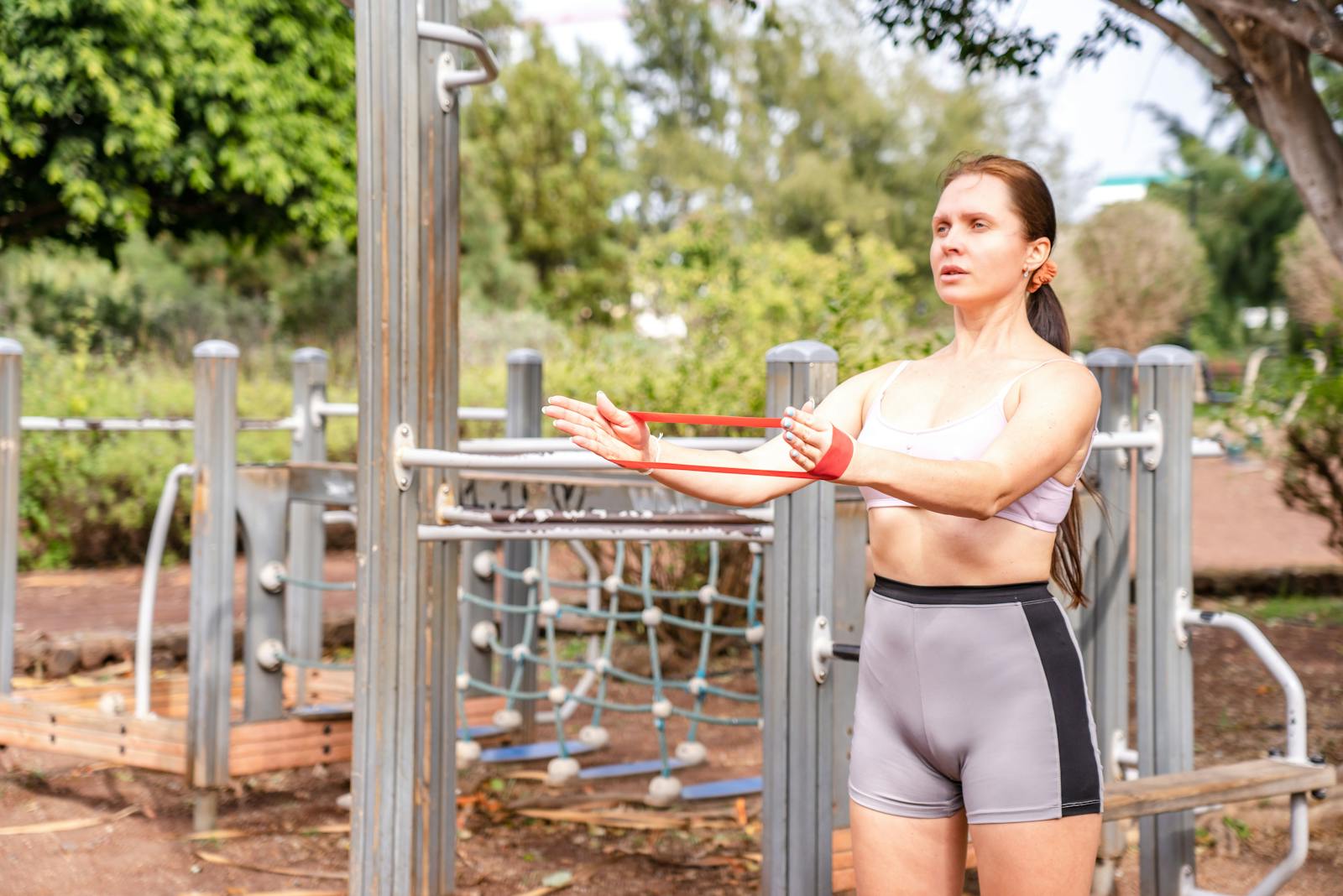
9. Band Rear Delt Fly
Hold band with both hands at chest height, arms extended forward. Pull the band apart by drawing arms straight out to the sides, squeezing shoulder blades. Slow eccentric.
Sets & reps: 3 sets of 15-20 reps.
Why it works: the rear deltoid is the most undertrained shoulder muscle in most lifters. Band rear delt flies hit it directly with constant tension. Improves posture, balanced shoulder shape, and pressing strength.
4-Week Resistance Band Arm Program
Two arm sessions per week, 30 minutes each. Pair with overall strength training (or use this as your primary arm work if training at home with bands).
| Week | Day A (Push Focus) | Day B (Pull/Shoulder Focus) |
|---|---|---|
| 1 | Tricep Pushdown 3×12 · Overhead Extension 3×10 · Lateral Raise 3×12 · Standing Curl 3×12 | Hammer Curl 3×12 · Concentration Curl 3×10 · Rear Delt Fly 3×15 · Front Raise 3×10 |
| 2 | Tricep Pushdown 3×15 · Kickback 3×12 · Lateral Raise 3×15 · Standing Curl 3×15 | Hammer Curl 3×15 · Concentration Curl 3×12 · Rear Delt Fly 3×20 · Lateral Raise 3×12 |
| 3 | Tricep Pushdown 4×12 · Overhead Extension 3×12 · Standing Curl 3×15 · Lateral Raise 3×12 | Hammer Curl 4×12 · Concentration Curl 3×15 · Rear Delt Fly 3×20 · Front Raise 3×12 |
| 4 | Light versions, 3×15 each | Light versions, 3×15 each |
Run twice (8 weeks total). Progressive overload comes from using heavier bands as the lighter ones become easy. Most beginners can graduate from light to medium bands within 4-6 weeks; from medium to heavy within 8-12 weeks.
Setup Tips That Actually Matter
Stance width controls tension. When standing on a band, wider stance increases tension at the start position; narrower stance reduces it. Adjust for the right level of challenge per exercise.
Anchor securely. Door anchors are the most common solution for overhead exercises. Get a quality door anchor (don't use thin straps that can slip). Tree branches or sturdy poles work outdoors.
Don't let the band snap back. Slow eccentric is more important with bands than free weights. The natural elastic recoil wants to snap the band back fast — resist it. 3-second descent on every rep.
Match band thickness to exercise. Triceps and shoulders typically need lighter bands; biceps and back need heavier ones. Most kits include 4-5 levels for this reason.
Combine bands when needed. If your heaviest band is too easy for an exercise, layer two bands together for additional resistance. Doubling up creates a much heavier overall load.
Resistance Band vs. Dumbbells
| Aspect | Bands | Dumbbells |
|---|---|---|
| Cost | $15-30 (full set) | $50-200+ for usable range |
| Storage | Fits in a drawer | Floor space required |
| Travel | Easy | Impossible |
| Constant tension | Yes | No (top-of-rep dead zone) |
| Maximum load | Limited (60-80 lb equivalent) | Unlimited progression |
| Joint friendliness | Excellent | Good |
| Best for | Home, travel, beginners, joint-sensitive | Heavy progressive overload, gym |
For most home arm training under 8-12 month time horizons, bands work as well as dumbbells. Past that point, especially for advanced lifters, dumbbells' unlimited progression becomes valuable. The combination of both — bands for travel/quick sessions, dumbbells for the main strength work — is ideal.
Common Mistakes With Band Arm Training
1. Using bands that are too light. If 15 reps feels easy, go heavier. Resistance training requires the muscle to fatigue near the end of the set. Light bands for high reps build endurance, not size.
2. Letting the band recoil fast. The eccentric (band-shortening, return to start) phase is where most muscle adaptation happens. Slow it down — 3 seconds, controlled.
3. Cheating with body movement. Swinging the torso during curls, leaning back during raises. Use the bands strict, not loose. The constant tension means even "light" bands work the muscle hard if form stays clean.
4. Skipping the squeeze. Bands provide their hardest tension at the peak contraction. Pause for 1 second at the top of each rep — that's where the most adaptation happens with band exercises.
5. Using bands that are wearing out. Bands degrade over time. Cracks, frayed fabric, or unusual stretchiness mean the band is past its life. Replace at first signs of wear — a band that snaps mid-rep can cause real injury.
Frequently Asked Questions
Can resistance bands build real muscle? Yes. Research consistently shows resistance band training produces strength and size gains comparable to free-weight training when load and effort are matched. The constant-tension nature of bands actually has some hypertrophy advantages over dumbbells.
How long until I see results? Strength gains: 2-4 weeks. Visible muscle development: 6-10 weeks. Visible arm change: 8-12 weeks of consistent training combined with adequate protein intake.
What resistance level should I start with? Beginners: light (5-15 lb resistance). The band should make the last 2-3 reps of each set genuinely challenging. If 15 reps feel effortless, go up a level.
Can I do bands every day? Light band work daily is fine — it's how many physical therapists program rehab. For muscle building, 2-3 sessions per week with 48-hour recovery between is optimal.
Are loop bands or tube bands better? Tube bands with handles tend to be more comfortable for arm work and easier to grip. Loop bands work but require holding the band itself, which can be awkward for some exercises. For pure arm training, tube bands win.
Will bands eventually plateau? Yes — most home exercisers eventually max out their heaviest band's difficulty after 6-12 months. At that point, you have options: combine bands for added load, add tempo work and increased volume, or transition to dumbbells/cables for continued progression.
Can older adults use resistance bands? Excellent for older adults — joint-friendly, scalable, accessible. Many physical therapy and senior fitness programs use bands as their primary modality for these reasons.
What if my bands are too light? Combine multiple bands together to multiply resistance. Two heavy bands together can match or exceed dumbbell training intensity for most arm exercises.
The Bottom Line
Resistance bands are the most accessible and travel-friendly tool for serious arm training. The 9 exercises in this article cover biceps (3), triceps (3), and shoulders (3), running through a complete arm session in 30 minutes.
For home gym setups, beginners, travel, or anyone wanting joint-friendly resistance, bands deliver strength and muscle gains comparable to free weights for the first 6-12 months of training. After that point, you may want to add or transition to dumbbells for continued heavy progression.
The single best $25 fitness investment most people can make: a quality multi-resistance band set with door anchor. Pairs with the 4-week program in this article for a complete home arm training routine.
Related reading: 5 Best Long-Head Bicep Exercises for the bicep peak development with bands or dumbbells, Cable Shoulder Workouts for the gym-based shoulder pairing, and Walmart Dumbbells Guide for when you're ready to upgrade.