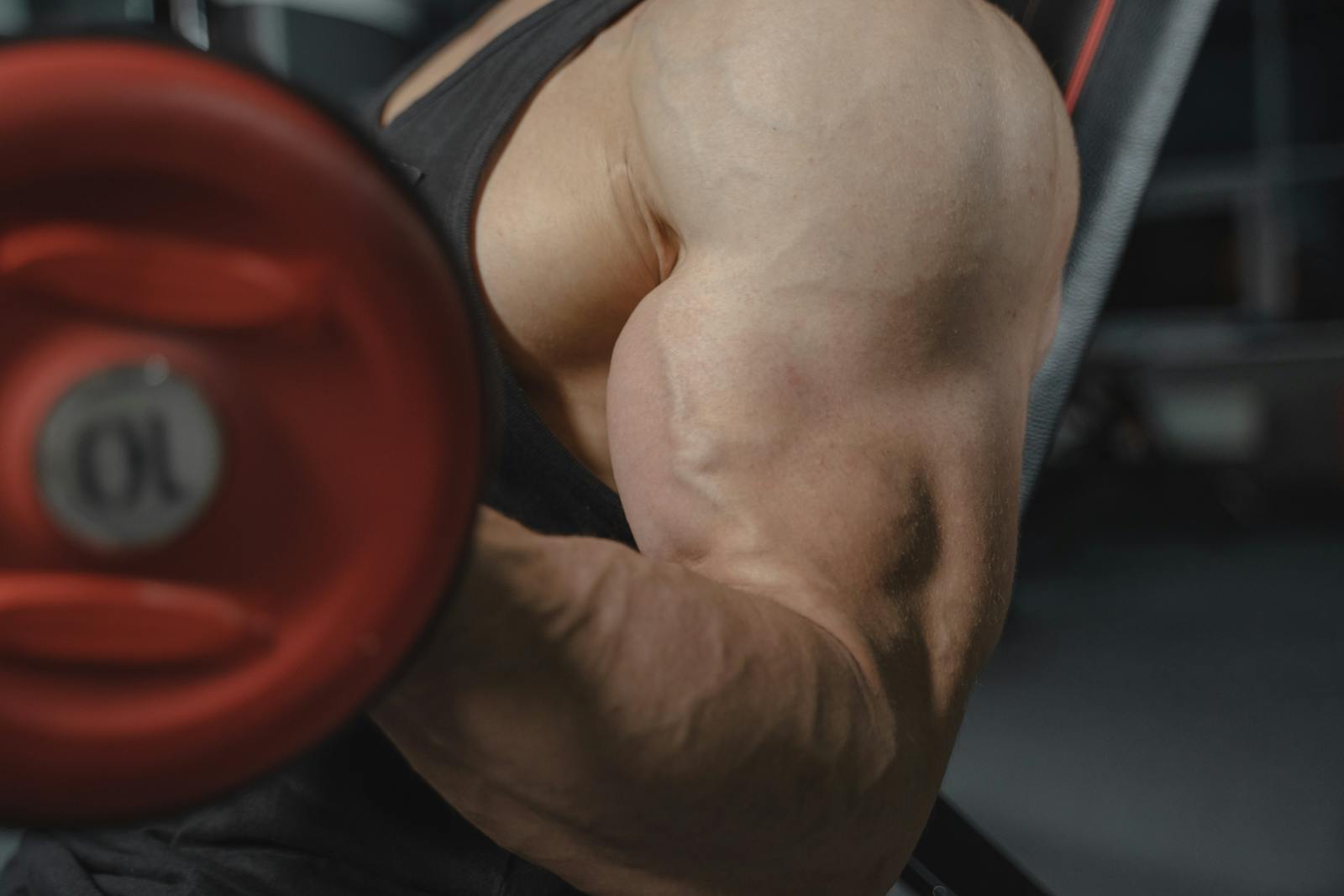
The “thickness” of a flexed bicep — that wide, full look from the front — comes mostly from the short head of the biceps brachii. While the long head builds the peak you see from the side, the short head is what makes the bicep look big when someone is staring directly at you. Below: the 6 best short-head bicep exercises, the form cues that make them work, and a 4-week program for thicker, fuller arm development.
Why the Short Head Builds Bicep Width
The short head of the biceps brachii originates from the coracoid process — a bony bump on the front of the scapula — and runs down the inside of the upper arm to attach with the long head at the radius (forearm). Anatomically, it sits on the inside of the arm, which is why it dominates the visual when you flex from the front.
To bias the short head, you need exercises where the shoulder is in flexion — arm in front of the body — rather than extension. This is the opposite of long-head training. Preacher curls, spider curls, and concentration curls all put the arm in front of the torso, slacking the long head and forcing the short head to do the work.
The width and thickness this produces is what makes a bicep look big when you're looking at someone face-to-face. The long head builds height; the short head builds presence.
Arms in front of the body = short head emphasis. Arms at the side or behind = long head emphasis. Want a thicker, fuller bicep look? Train short head. Want a taller peak? Train long head. Want both? Hit both heads each week.
The 6 Best Short-Head Bicep Exercises
1. Preacher Curl (Barbell or EZ Bar)
The textbook short-head exercise. Sit at a preacher bench with arms draped over the pad. Curl the bar from full extension to full contraction.
Why it works: The preacher pad keeps your arms locked in front of the torso throughout the rep. The long head can't help — short head does almost all the work. Excellent for forced isolation.
Sets & reps: 3-4 sets of 8-12 reps. Use an EZ bar to reduce wrist strain compared to a straight bar.
Form cues: Don't hyperextend the arm at the bottom — control the descent and stop just before lockout. Keep elbows locked into the pad to prevent forward drift.
2. Spider Curl (Incline Bench Face-Down)
Lie face-down on an incline bench with arms hanging straight down. Curl the dumbbells up while keeping your upper arms perpendicular to the floor.
Why it works: The position pre-stretches the short head while keeping the long head slack. The spider angle also forces strict form — you can't cheat with body english because you're lying down.
Sets & reps: 3 sets of 10-12 reps. Squeeze for a 1-second pause at the top of every rep.
3. High Cable Curl (Crucifix Curl)
Both pulleys at the highest setting, arms extended out to the sides at shoulder height (the "crucifix" or "double-bicep pose" position). Curl both hands toward your head.
Why it works: Massive shoulder flexion + abduction puts the short head into a fully shortened, deeply contracted position at the top. Constant cable tension means the squeeze actually loads the muscle.
Sets & reps: 3 sets of 12-15 reps. Light weight, focus on the squeeze.

4. Concentration Curl
Sit on a bench, lean forward with one elbow braced against the inside of the same-side knee. Curl the dumbbell up while keeping the elbow pinned against the knee.
Why it works: Pure isolation — zero help from the rest of the body. The braced position keeps the arm in front of the torso. The mind-muscle connection is one of the highest of any bicep exercise.
Sets & reps: 3 sets of 10-12 reps per arm. Used as a finisher rather than a primary lift.
5. Wide-Grip Barbell Curl
Standard standing barbell curl with hands wider than shoulder-width. Wider grip biases the short head; narrower grip biases the long head. Wide grip + standing position = short head emphasis with heavy loading potential.
Why it works: The grip width matters more than people realize. Wide grip rotates the shoulders into more flexion, putting the short head in a stronger position relative to the long head.
Sets & reps: 3-4 sets of 8-10 reps. The strength move of short-head training — load it heavy.
Form cues: No shoulder swing. Elbows pinned to the sides. Wider hands than you think you need.
6. Standing Cable Curl (Bar Attachment)
Cable at the lowest position with a straight or EZ bar. Stand close to the cable. Curl with elbows tight to the body.
Why it works: Constant tension version of the standard curl. Doesn't bias short head as strongly as preacher or spider, but the cable tension makes it superior to standard barbell curls for hypertrophy. Use as a high-volume finisher.
Sets & reps: 3 sets of 12-15 reps. Last exercise of arm work — burn out the muscle.
4-Week Short-Head Bicep Program
| Week | Day A (Strength + Volume) | Day B (Pump Focus) |
|---|---|---|
| 1 | Preacher Curl 4×8 · Wide-Grip BB Curl 3×10 · Spider Curl 3×12 | High Cable Curl 3×15 · Concentration Curl 3×12 · Standing Cable 3×15 |
| 2 | Preacher Curl 4×10 · Wide-Grip BB 3×10 · Concentration 3×10 | Spider Curl 3×12 · High Cable 3×15 · Standing Cable 3×15 |
| 3 | Preacher Curl 5×6 (heavy) · Spider 3×10 · Concentration 3×10 | Wide-Grip BB 3×12 · High Cable 3×15 · Standing Cable 3×20 |
| 4 | Preacher Curl 3×12 (deload) · Spider 3×12 · Concentration 3×15 | High Cable 3×15 · Standing Cable 3×20 · Light arm finisher |
Two arm sessions per week, alternating focus between strength and pump. Pair with at least one long-head session per week (incline curls, hammer curls) for balanced bicep development. Visible thickness change typically shows in 6-10 weeks.
The 4 Form Mistakes That Kill Short-Head Development
1. Letting elbows drift back on preacher curls. If your elbows lift off the pad as you fatigue, you lose the entire benefit of the preacher position. Drop the weight before that happens.
2. Bouncing out of the bottom. Most lifters bounce the weight at the bottom of preacher and barbell curls, using elastic recoil instead of muscle. Pause 1 second at the bottom of every rep. The drop in weight you'll have to take is real, but the stimulus quality jumps significantly.
3. Going too narrow on barbell curls. Narrow grip biases long head. Most people use a too-narrow grip and wonder why their short head doesn't grow. Hands wider than shoulder-width for short head.
4. Skipping cable work. Free weights have a sticking point in the middle of the curl where the load decreases. Cables maintain tension throughout. If your routine is all dumbbells and barbells, you're missing the most growth-productive part of the rep.
Combining Short-Head and Long-Head Training
For complete bicep development, hit both heads each week. The most effective splits:
Two arm days per week: One long-head focused (incline curls, Bayesian cable, hammer), one short-head focused (preacher, spider, wide-grip BB). 4-5 exercises per session.
One arm day per week: Mix both heads in the same session. Order by exercise priority — heavy compound first (could be wide-grip BB curl or incline curl), then alternate emphasis. 6-8 total bicep exercises.
Push/Pull/Legs split: Biceps as accessory after pull day. Alternate weeks — long-head bias one week, short-head bias the next.
Total weekly volume target: 12-18 working sets across both heads combined. Below 10 and progress slows. Above 20 and recovery becomes the bottleneck.
Why “Just Doing Curls” Doesn't Build Either Head Well
The most common bicep training pattern: standing barbell curls, dumbbell curls, maybe a preacher curl thrown in occasionally. This trains the bicep, but it doesn't emphasize either head specifically — and the result is moderate development across the board with a peak that doesn't pop and width that doesn't fill out.
The alternative: deliberately bias one head per session. Pick exercises based on shoulder position. Track progress on the specific exercises that target your weak head. Within 8-12 weeks, the imbalance closes.
Volume Progression Across the 4-Week Program
The 4-week program above progressively increases volume and intensity, then deloads. Here's why each week is structured the way it is:
Week 1: Establish movement patterns at moderate volume. Goal — focus on form, identify weak points.
Week 2: Same exercises, slightly more reps. Goal — push the rep ranges up while form stays clean.
Week 3: Heavy week. Drop reps on compound movements (preacher curl 5×6), use heavier loads. Volume on isolation stays similar. Goal — strength + size simultaneously.
Week 4: Deload week. Drop volume by 30-40%, drop intensity by 10-15%. Goal — recover, set up the next progression block.
Most lifters who run this 4-week structure twice (8 weeks total) see meaningful short-head change. Those who run the same workout every week for 8 weeks usually plateau by week 4 because the body adapts and stops responding to identical stimulus.
Frequently Asked Questions
Do I need to train both heads if I just want bigger arms? Yes. Training only one head produces unbalanced results that look unfinished. The triceps make up 2/3 of the upper arm, so total arm size is mostly tricep work — but for the bicep portion, both heads contribute to overall mass.
How fast does short-head growth show? Visible thickness change in 6-10 weeks of consistent training. The short head responds quickly to volume because most lifters have neglected it. Beginners see change even faster (3-5 weeks).
Are preacher curls hard on the elbow? Some people experience elbow strain from the angle. If you do, switch to a Scott bench or use lighter weight + slower tempo. The EZ bar grip is much more forearm-friendly than a straight bar.
What about reverse curls? Reverse curls (palms-down grip) train the brachialis and brachioradialis more than the biceps. They're excellent for arm thickness overall but don't bias short head specifically.
Do I need a gym for short-head work? No. Spider curls (face-down on a bench), concentration curls (sitting on a chair), and chin-ups all work at home. Bands held under your foot can substitute for cable work. Loading is harder at home but the patterns work.
How heavy should preacher curls be? Lighter than your standing curls — typically 60-70% of standing curl weight. The leverage is much harder. If you're using the same weight, you're cheating somehow.
Should I do short-head work before or after long-head work? Doesn't matter much. Most lifters do compound movements first (heavy preacher or wide-grip BB curl) and isolation last (concentration curls), regardless of which head they emphasize.
Why do my biceps feel sore but never grow? Soreness doesn't equal growth. Growth requires progressive overload — adding weight, reps, or improving form over time. Sore-but-not-growing usually means you're training the same way week after week with no progression. Track lifts, push the load, and watch the muscle respond.
The Bottom Line
The bicep's thickness — the wide, full appearance from the front — is built by the short head. To grow it specifically, train with arms in front of the torso (preacher, spider, concentration, high cable curls) rather than the at-side or behind-the-body positions that bias the long head.
The single most effective swap for short-head emphasis: replace your standing barbell curl with a wide-grip preacher curl. Same volume. Different muscle stimulus. Within 6-8 weeks, the front of your bicep starts to look fuller.
Related reading: 5 Best Long-Head Bicep Exercises for Peak Development for the companion piece, Cable Shoulder Workouts for arm-aesthetic shoulder support, and How Much Protein Do You Need for muscle-building nutrition.