
Knee pain is one of the most common reasons people stop exercising, and one of the reasons they shouldn’t. Targeted strength work around the knee — the muscles of the thigh, glute, and calf — is consistently one of the best-supported interventions for common knee issues. But the wrong exercises can make things worse, sometimes significantly.
This article covers the distinction: which common exercises tend to aggravate bad knees, which alternatives build the supporting strength most people need, and — most importantly — when the right move is to stop reading articles and see a physical therapist or doctor.
An important note on scope
This article is not medical advice. If you have a diagnosed knee condition, a recent injury, or pain that lasts more than a few days, see a qualified professional before starting any new exercise program. Nothing below replaces that. Everything below assumes you’ve already been cleared to exercise.
When to see a doctor instead of reading more articles
Some situations call for professional assessment before any exercise change. If any of the following apply, get evaluated first:
- Sharp pain during movement, not just discomfort or ache.
- Swelling, heat, or visible redness in the knee.
- Pain that wakes you up at night or is present at rest.
- A recent injury — twisting, fall, impact, or audible “pop.”
- Inability to fully straighten or bend the knee.
- A feeling of instability or the knee “giving way” during normal activity.
- Pain that lasts more than 10–14 days despite modifying activity.
A physical therapist (PT) is almost always the right first stop. They can evaluate your specific movement patterns and give you a tailored program. Many insurance plans allow direct access without a primary care referral. Generic advice from the internet — including this article — is a poor substitute for a 45-minute evaluation with someone who can watch you walk, squat, and step.
Why the knee gets cranky (quick anatomy primer)
The knee is a hinge joint between the thigh bone (femur) and the shin bone (tibia), with the kneecap (patella) riding on the front. It depends on the strength and balance of several muscle groups to track correctly through each movement:
- Quadriceps (front of thigh) — extend the knee, directly influence patellar tracking.
- Hamstrings (back of thigh) — bend the knee, counterbalance the quads.
- Glutes — control hip rotation, which heavily influences knee alignment.
- Calves — support the ankle, which affects how load transmits up to the knee.
Most common non-injury knee pain comes from imbalances in these groups — weak glutes, overactive quads, tight hamstrings — combined with poor tracking under load. Strengthen the support system and tracking improves. That’s why exercise often helps, even though it seems counterintuitive to “work through” a knee issue.
Exercises commonly tough on bad knees
These exercises aren’t universally forbidden — some people with healthy knees can do them fine. But if you have ongoing knee pain, each of these creates load patterns that tend to worsen common issues. Skip them or modify until a professional clears you for the full version.
1. Deep barbell squats (especially with heavy load)
Why it’s hard on knees: at full depth with heavy external load, compressive forces on the knee joint and patellar tendon are maximal. If your form isn’t dialed in — knees caving, heels lifting, torso collapsing forward — those forces land in bad places.
What to do instead: goblet squats to a parallel depth with moderate weight, or box squats where you sit onto a bench and stand back up. Both load the quads and glutes without the extreme compressive loading at the bottom.
2. Jump squats and other high-impact plyometrics
Why it’s hard on knees: landing from a jump produces ground reaction forces of 2–5× body weight through the knees. For a healthy joint, this is great training. For a cranky one, it’s accelerating wear.
What to do instead: bodyweight squats with a fast concentric (drive up fast, no jump). Same power-development stimulus, zero impact. Add step-ups onto a low box for mild dynamic loading as tolerance improves.
3. Deep forward lunges
Why it’s hard on knees: the front knee takes significant load at the bottom of a forward lunge, and deceleration on the way down multiplies that load. Range of motion matters — shallow lunges are often fine, deep ones often aren’t.
What to do instead: reverse lunges (easier on the front knee because there’s no deceleration phase), stationary split squats with a shallower range, or step-ups onto a low box.
4. Running downhill or on hard surfaces
Why it’s hard on knees: the eccentric braking of downhill running produces peak forces through the patella. Hard surfaces (concrete, pavement) transmit more of that force than softer surfaces.
What to do instead: walk briskly on a flat or slightly uphill surface, switch to trail or track running, or move to low-impact cardio options like cycling, elliptical, or swimming during flare-ups.
5. High-step aerobics and jumping rope
Why it’s hard on knees: repetitive impact combined with rapid directional changes. Stepping up onto a box at height, thousands of reps, accumulates as much load as running.
What to do instead: a step-up program on a lower box with fewer reps, or substitute a seated cardio like a recumbent bike for the same elevated heart rate.
6. Leg extension machine (in some cases)
Why it can be hard on knees: leg extensions isolate the quads and produce significant shear force on the patellar tendon — particularly in the last quarter of the movement (near full extension).
What to do instead: partial-range leg extensions (bottom two-thirds of the range only), goblet squats, or terminal knee extensions with a resistance band, which are often prescribed by PTs for patellar tracking work.
Exercises that usually help knees

Every case is different, but these exercises are consistently recommended by PTs for building the supporting strength around the knee. They load the joint appropriately rather than extremely, and they address common weaknesses that cause pain.
Glute bridges
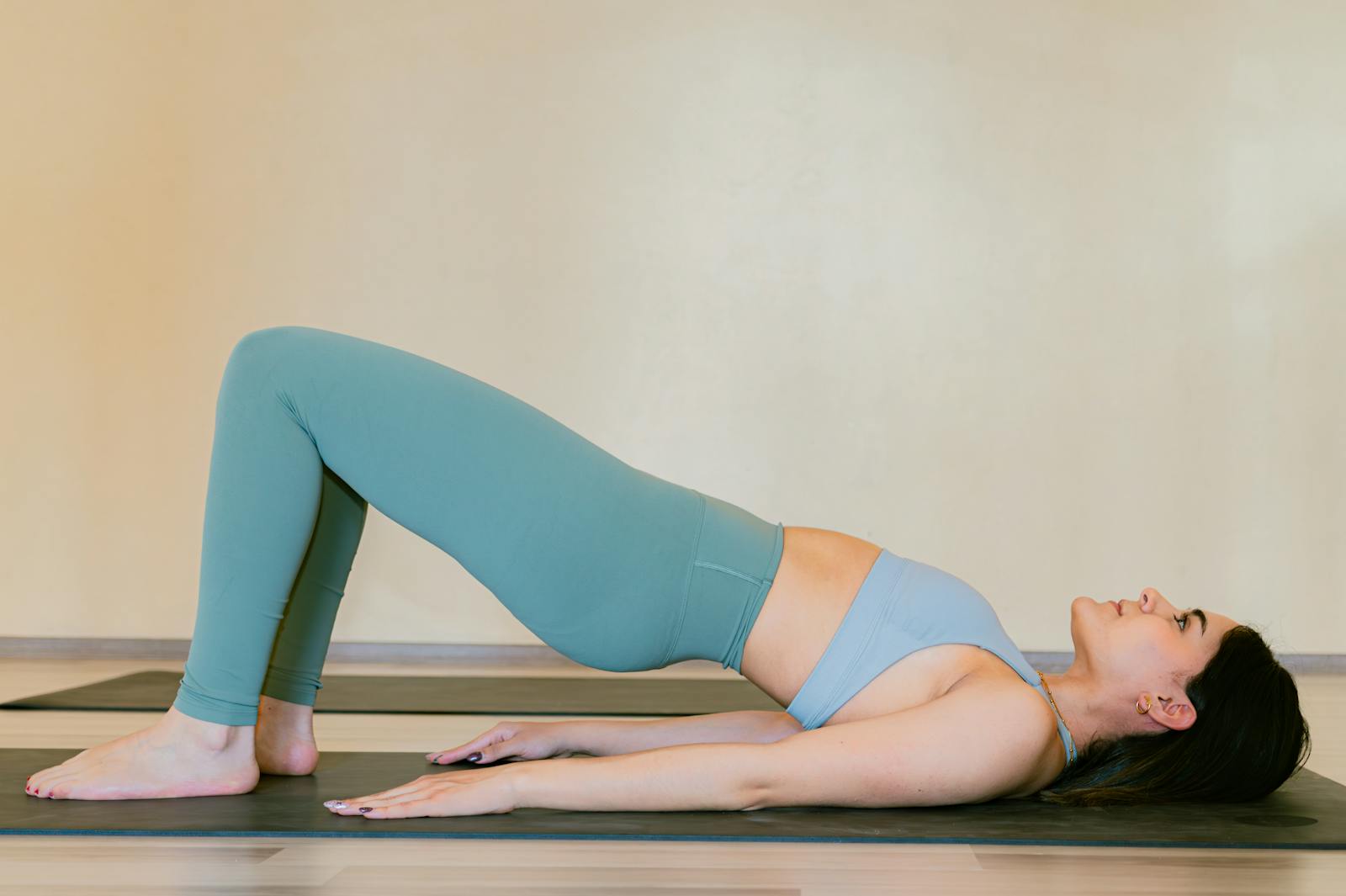
Lie on your back, knees bent, feet flat. Drive hips up to form a line from knees to shoulders. Squeeze the glutes at the top. 3 sets of 10–15 reps.
Why it helps: builds glute strength without loading the knee at all. Weak glutes are the single most common contributor to knee pain.
Wall sits (in the pain-free range)
Slide down a wall until your thighs are at a comfortable angle — not necessarily 90 degrees. Hold 20–45 seconds. 3 rounds.
Why it helps: isometric quad strengthening with minimal joint movement, which is usually well-tolerated even when dynamic movements hurt. Keep the angle shallow enough that it doesn’t reproduce your pain.
Straight-leg raises
Lie on your back, one leg straight, the other bent with foot flat. Lift the straight leg to the height of the bent knee. 3 sets of 10 per side.
Why it helps: isolated quad strengthening with zero knee bend — gentle, accessible, and one of the most common PT-prescribed exercises for knee rehab.
Clamshells
Lie on your side, knees bent at 45 degrees, heels together. Keeping heels touching, rotate the top knee up while keeping your pelvis still. 3 sets of 15 per side.
Why it helps: targets the gluteus medius — the often-forgotten muscle that controls hip rotation and directly influences how the knee tracks.
Step-ups (on a low box)

Stand in front of a sturdy box 4–8 inches high. Step up with one foot, bring the other up to meet it, step back down with the same lead foot. 3 sets of 10 per leg.
Why it helps: functional single-leg strength work in a shallow range. Scale the box height up as tolerance improves — this is the most progressable knee-friendly exercise on the list.
Stationary cycling
A stationary bike with a moderate resistance level, 15–30 minutes, 3–5 times per week.
Why it helps: low-impact cardiovascular work that also strengthens the quads through the pedaling motion. The circular motion distributes load across the whole rotation rather than concentrating it at any single angle.
Swimming and pool walking

Swimming laps or walking laps in the shallow end of a pool, 20–45 minutes.
Why it helps: buoyancy removes almost all impact from the knee. Pool walking specifically provides a resistance profile similar to land walking but with a fraction of the joint load — ideal during flare-ups.
A sample weekly plan for knee-friendly strength

If you’ve been cleared to exercise and want a starting structure, this 3-day plan hits supporting strength, cardio, and mobility without the high-load movements on the avoid list.
| Day | Workout | Time |
|---|---|---|
| Mon | Strength circuit: glute bridges, clamshells, straight-leg raises, wall sits, step-ups. 3 rounds. | 30 min |
| Tue | Stationary bike or pool walking, moderate effort. | 25 min |
| Wed | Rest or gentle walking. | — |
| Thu | Strength circuit (same as Monday). | 30 min |
| Fri | Stationary bike or swimming. | 25 min |
| Sat | Mobility: hip stretches, calf stretches, ankle rocks, foam roll. | 15 min |
| Sun | Rest. | — |
This plan rebuilds supporting strength without exposing the knee to high-impact or deep-loaded movement. Most people find that consistent work at this level for 4–8 weeks meaningfully reduces day-to-day pain — at which point, with PT approval, you can progress toward more demanding exercises.
What else helps
Weight management
Every extra pound of body weight adds roughly 3–6 pounds of force across the knee joint during walking, and more during running or stairs. For people with knee pain and extra body weight, even modest weight loss (5–10% of body weight) consistently reduces pain and improves function. This is not about aesthetics — it’s mechanics.
A sustainable, non-restrictive approach to nutrition makes this much more achievable. The covers a framework built on protein and fiber at every meal.
Supportive footwear
Worn-out shoes lose their shock absorption, and misfit shoes often throw off foot-ankle-knee alignment. If you haven’t replaced your walking or running shoes in the last year, that’s often the cheapest intervention available.
Warm-up matters more with bad knees
Five minutes of easy movement before any strength work (bike, walk, gentle bodyweight warm-up). Cold joints tolerate load poorly; warm joints are much more resilient. Don’t skip this.
Frequently asked questions
Should I use ice or heat?
Both have their moments. Ice is useful immediately after activity if the knee swells or feels hot (15–20 minutes). Heat is useful before activity to loosen up stiff tissue. Neither “fixes” the underlying issue — but both help manage symptoms. A physical therapist can guide which is right for your specific situation.
Is it bad to hear clicking or popping in my knee?
Painless clicking (crepitus) is very common and generally not a problem. Painful clicking, or clicking accompanied by swelling or instability, should be evaluated. The sound itself isn’t diagnostic — the symptoms around it are.
Can I still do yoga?
Usually yes, with modifications. Avoid deep hero pose, child’s pose if it pinches, and any asymmetric deep knee bends that aggravate symptoms. Many poses are great for mobility and low-impact strength. A yoga instructor with therapeutic experience is worth seeking out.
Will my knees get worse if I keep exercising?
It depends entirely on what and how. The right kind of exercise — progressive, appropriate, focused on supporting strength — usually improves outcomes over time. The wrong kind (heavy, high-impact, asymmetric loading under poor form) accelerates problems. This is why professional assessment matters so much.
Should I wear a knee brace?
A brace can help in specific situations — instability, specific activities, post-injury recovery — and may be counterproductive in others because it can reduce supporting muscle engagement. This is a decision to make with a PT or doctor, not with an internet article.
How long before I know if exercise is helping?
Give a consistent program 4–6 weeks before deciding it isn’t working. Supporting strength takes time to build. If pain is noticeably worse after 1–2 weeks of any specific exercise, drop it and try something else. If general strength work isn’t helping after 6+ weeks, it’s time to revisit with a professional.
The bottom line
Bad knees need a strategy, not surrender. Avoid the exercises that consistently aggravate the joint (deep-loaded squats, high-impact plyometrics, heavy forward lunges). Focus on the exercises that build the supporting structure — glute bridges, wall sits, straight-leg raises, clamshells, step-ups, stationary cycling. Pair that with appropriate weight management and warm-up. And when in doubt, see a physical therapist before deciding what to do.
Exercise, done thoughtfully, is nearly always part of the answer to knee issues — not the thing to avoid. The knees you take care of in your 30s, 40s, and 50s are the knees you walk on in your 70s and 80s. That’s reason enough to start today.
More like this in our health & wellness guides library.