Both styles of skiing burn serious calories, build serious legs, and cost serious money — but that’s where the similarities end. Downhill (alpine) and cross-country (Nordic) skiing are essentially two different sports that happen to share the word “ski.” If you’re trying to decide which one fits your fitness goals, your wallet, or your weekend, the right answer depends on what you actually want out of it.
Cross-country skiing is the better workout by almost every fitness metric — higher cardio demand, more total muscle recruitment, lower injury risk, and a fraction of the cost. Downhill skiing wins on adrenaline, accessibility, and après-ski culture, and is more forgiving for casual fitness. If your goal is fitness, go Nordic. If your goal is the experience of being on a mountain, go alpine. Most people who do both end up loving them for different reasons.
The two sports at a glance
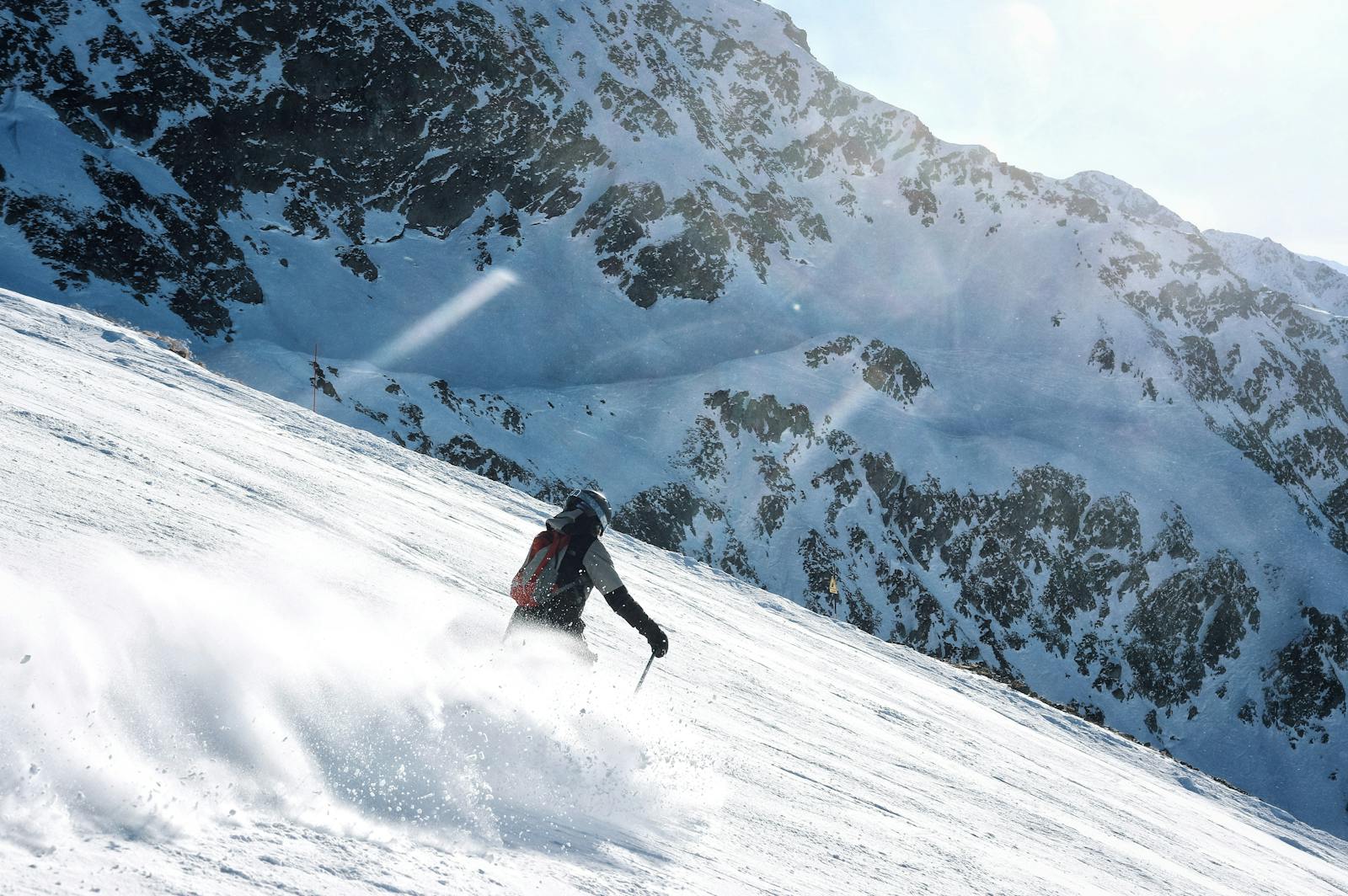
Downhill (alpine)
You ride a chairlift up, gravity pulls you down, you turn your skis to control speed. Movement is short bursts of effort — descents of 1-5 minutes — followed by long passive recovery on the lift.
- Average calorie burn: 350-500/hour
- Primary muscles: quads, glutes, core
- Cardio intensity: moderate (HR spikes during runs, rests during lifts)
- Cost to start: $1,500-3,000 for gear + $80-200/day lift tickets
- Learning curve: 3-5 days for a basic blue run
Cross-country (Nordic)
You glide across flat or rolling terrain under your own power, propelling yourself with a kick-and-glide motion (classic) or skating-like push (skate). Continuous effort for 30-90 minute sessions.
- Average calorie burn: 500-800/hour
- Primary muscles: nearly every major group
- Cardio intensity: high (sustained zone 3-4)
- Cost to start: $400-700 for gear + $20-30/day trail pass
- Learning curve: 1-2 days for basic gliding
Calorie burn — cross-country wins, decisively
Compare the same person, same hour, on each:
- A 150-pound person downhill skiing burns roughly 350 calories per hour on intermediate terrain. Most of that comes during the actual descent — the chairlift gives you a long passive break that drops your heart rate back to near resting.
- The same person cross-country skiing burns 500-700 calories per hour on rolling terrain, and 700-900 calories per hour on the more aerobic skate-skiing technique. There are no breaks. The only thing slowing you down is your conditioning.
For the body weight category, cross-country skiing is at the top of the calorie-burn rankings — comparable to running 8-minute miles, swimming hard, or cycling at race pace. It’s the highest-output endurance sport you can do that doesn’t involve any joint impact. Downhill, by contrast, sits in the same calorie ballpark as moderate hiking or recreational tennis.
For someone who wants to use snow as a fitness tool, this difference matters. Three hours of cross-country skiing is roughly equivalent to running 12 miles, in terms of caloric expenditure. Three hours of downhill (with chairlift recovery) is closer to a brisk hike.
Muscle groups — Nordic recruits everything, alpine emphasizes legs
Downhill skiing is a leg-and-core sport. Quads handle the constant micro-flexion, glutes and adductors stabilize the turn, and the core bridges the upper and lower body. Arms and shoulders contribute via pole plants but it’s secondary. After a hard day on the mountain, your quads will tell you exactly which muscle did most of the work.
Cross-country skiing recruits the legs plus the entire upper body. Each pole plant drives through your triceps, lats, and core; each kick engages glutes, hamstrings, and calves. Skate skiing in particular recruits the gluteus medius and inner thighs in ways that almost no other sport does. This is why elite Nordic skiers consistently top VO2 max measurements — the sport demands oxygen across nearly every muscle group simultaneously.
For training carryover to other sports:
- Alpine builds quad strength and proprioception that transfers to cycling, running downhill, and lateral sports (tennis, soccer).
- Nordic builds aerobic capacity and full-body endurance that transfers to running, rowing, swimming, and any other endurance discipline.
Intensity profile — bursts vs. sustained
Downhill skiing follows an interval pattern: 60-180 seconds of high-intensity effort during the run, followed by 5-15 minutes of near-zero effort on the lift. This is broadly similar to the structure of HIIT, with much longer rest intervals. Heart rate during a hard run can spike to 85-90% of max; on the lift it falls back to 50-60%.
Cross-country skiing is the opposite: sustained effort in heart rate zones 3 to 4 (roughly 70-85% of max) for the entire session. There’s no equivalent rest period unless you stop. The cardiovascular adaptations from this kind of training — improved stroke volume, better mitochondrial density, larger oxidative capacity — accumulate fast.
Cost — Nordic is dramatically cheaper
| Cost category | Downhill | Cross-country |
|---|---|---|
| Skis (entry-level) | $400-800 | $200-350 |
| Boots (entry-level) | $300-500 | $120-200 |
| Bindings | $150-250 | $70-120 |
| Poles | $50-100 | $40-80 |
| Helmet (recommended) | $80-150 | Not required |
| Outerwear | $300-600 (insulated) | $150-300 (less insulation) |
| Day pass / trail fee | $80-200 | $15-30 |
| Lessons (4-day group) | $300-500 | $80-150 |
A first season into downhill skiing usually runs $2,000-4,000 once you factor in gear, lift tickets, lodging, and food at resorts. A first season into cross-country can run $500-800 if you buy used skis and ski mostly at public Nordic centers or groomed-trail networks. The renewable cost gap is even bigger: a season of weekend lift tickets at a major resort easily exceeds $2,000; the equivalent in trail passes is under $300.
Both sports have rental options if you want to try before committing. Most ski resorts offer rentals for $40-70/day; Nordic centers usually rent for $20-30/day.
Learning curve — Nordic is easier to start, harder to master
If you’ve never been on skis, you can be gliding usefully on cross-country gear within a couple of hours. The classic technique (kick and glide) is intuitive — it’s essentially walking with a slide. Skate skiing is harder and takes a few sessions to feel coordinated, but it’s not technical in the way alpine is.
Downhill skiing has a steeper initial wall. The first day is mostly about not falling. Day two you start to make basic turns. By day five you’re surviving blue runs but probably not enjoying them yet. The learning curve plateaus after that — most recreational skiers stay in an intermediate skill band forever, which is fine.
What’s deceptive is the upper ceiling. Cross-country skiing at the elite level is one of the most technical aerobic sports in existence — efficient skate skiing requires years of practice to master, and the difference between a good and great cross-country skier is enormous. But you don’t have to climb that ceiling to get a great workout from it.
Injury risk — alpine is far higher
Downhill skiing has a non-trivial injury rate. The most common injuries are knee ligament tears (especially ACL), thumb sprains from the pole strap, and shoulder dislocations from falls. Helmet use has cut head-injury rates by roughly 35% according to ski industry data, but knee injuries remain stubborn — about 1 in 1,000 skier-days. Big mountain, expert terrain, fatigue late in the day, and ice all push that rate higher.
Cross-country skiing has roughly a tenth of the injury rate of alpine. The most common cross-country injury is wrist or shoulder strain from falls on icy patches, plus repetitive-stress issues like adductor strains in skate skiers. There are no high-speed collisions, no sudden compressions, and the falls are almost always low-energy.
If you have prior knee issues — old ACL surgery, meniscus damage, chronic patellar pain — cross-country skiing is significantly more knee-friendly. The motion is closer to running than to landing.
Terrain access
Downhill skiing requires a developed mountain with chairlifts, groomed runs, ski patrol, and a sizable budget. There are roughly 470 ski resorts in the US, concentrated in Colorado, Utah, the Northeast, and the Sierras. If you don’t live near one, downhill is a destination sport — flights, lodging, the whole production.
Cross-country can happen anywhere snow falls. State parks, golf courses in winter, public-land Nordic centers, even neighborhood parks. There are roughly 1,200 dedicated cross-country trail networks in the US, plus thousands of informal options. The barriers to access are far lower; for many people, a 20-minute drive gets you on snow.
Who should pick which?
| If your priority is… | Pick |
|---|---|
| Fitness and calorie burn | Cross-country |
| Adrenaline and the mountain experience | Downhill |
| Lowest cost to start and sustain | Cross-country |
| Easiest learning curve at the start | Cross-country |
| Lowest injury risk | Cross-country |
| Knee-friendly with prior injury | Cross-country |
| Social après-ski / vacation atmosphere | Downhill |
| Doing it casually with kids | Downhill (lessons available + social) |
| Cross-training for endurance sports | Cross-country |
| Mostly to enjoy the scenery and exercise | Cross-country |
Common mistakes when starting
Buying gear before knowing the sport. Both sports have gear that’s specific to your weight, technique, and ability. Rent or borrow for a season before buying — you’ll know what fits when you’ve spent enough days to develop preferences.
Skipping lessons. Both sports reward technique heavily. A few lessons in your first season pays back hundreds of hours of solo flailing. Group lessons are inexpensive and surprisingly fun.
Underdressing for cross-country. The mistake new Nordic skiers make is dressing for “outdoor cold” instead of “exercising in the cold.” You generate enormous body heat once you start moving — wearing a heavy jacket leads to soaking sweat and chills. Layer light: base, thin midlayer, light shell.
Overdressing for downhill. The mistake new alpine skiers make is dressing for the run instead of the lift. The chairlift is when you get cold; the run is when you sweat. Insulated base layers under a windproof shell let you regulate by zipping/unzipping.
Trying to learn skate-ski before classic. Skate skiing is faster and looks cooler, but it’s much harder. Spend a season on classic technique first. The base fitness and balance carry over.
Frequently asked questions
Which is harder on the knees?
Downhill is significantly harder on the knees. The repeated micro-flexion against gravity, occasional impact from terrain, and risk of awkward falls all stress the knee joint. ACL tears are the signature injury of alpine skiing for a reason. Cross-country is closer to walking or running in joint impact — minimal compression, no rapid direction changes, almost no sudden stopping.
Can I learn cross-country if I’ve never been on skis before?
Yes — cross-country (especially classic technique) is one of the most beginner-accessible winter sports. Most people are gliding usefully within an hour. The first week is about coordinating the kick-and-glide rhythm; after that it’s mostly endurance and route choice.
Is downhill skiing a good workout if I’m doing it twice a week?
It’s a workout — quads, glutes, and core get a lot of stimulus. But it’s not great cardiovascular conditioning by itself, because the lift rest periods are too long for sustained heart-rate elevation. Most serious recreational alpine skiers cross-train aerobically (cycling, running) for the cardio component.
Can I cross-country ski without snow?
Roller skis are the off-season tool — pavement-rolling versions of cross-country skis with the same boots and motion. Nordic skiers train year-round on roller skis. They’re $250-400 and work on any flat paved surface.
What’s “skate skiing” and how is it different from classic?
Classic technique is the kick-and-glide motion in two parallel grooves; skate skiing is V-shaped pushes off each ski like an ice skater. Skate is faster, more aerobic, and takes more skill. Both are cross-country. Most beginners start with classic and add skate later.
Do I need to be in good shape before I start cross-country skiing?
No, but you’ll be tired faster if you’re not. Cross-country builds its own fitness. Start with 30-minute sessions at conversational pace and build to 60-90 minute sessions over a few weeks. The aerobic base develops fast.
What about ski touring or backcountry — where does that fit?
Ski touring (alpine touring, AT) is a hybrid: you skin uphill on cross-country-like climbing skins, then ski downhill on alpine gear with the heel locked. The uphill is the workout (similar effort to Nordic), the downhill is the reward. It’s the best-of-both-worlds option for fit skiers willing to invest in heavier gear and avalanche education. Costs $1,500-2,500 to start beyond regular alpine.
Is one of them better for older adults?
Cross-country is generally better for older adults: lower injury risk, lower-impact, easier to scale to your fitness level. Plenty of 70-year-olds ski Nordic competitively. Downhill is also possible at older ages but the consequences of a fall are higher and the equipment is heavier.
The bottom line
Downhill and cross-country skiing are different sports for different reasons. Cross-country wins on every fitness metric that matters — calorie burn, cardio demand, full-body recruitment, injury safety, and cost. Downhill wins on the experience of being on a mountain, the social side, and the kind of pure adrenaline that nothing else delivers.
If forced to choose one and your goal is fitness, take Nordic. If your goal is the lifestyle and experience, take alpine. The honest answer for most people is that they’re complementary — alpine when you want to feel the mountain, Nordic when you want to feel like you’ve actually exercised.